You spend a few evenings building a template, guide, spreadsheet or ebook. You upload it, make the product page look respectable, hit publish—and then keep checking the dashboard.
Zero sales.
For a beginner, that is usually the point where the doubts start.
Maybe the product is bad. Maybe the price is wrong. Maybe Gumroad was the wrong choice. Maybe you should move to Etsy. Maybe you need 10,000 Instagram followers before any of this can work.
Not necessarily.
If you’re trying to sell digital products with no audience, the problem is rarely solved by switching platforms at random or posting everywhere at once. You need to answer three separate questions:
Does somebody actually want this?
Where can I reach people with that problem?
Does my offer give a stranger enough reason to buy from me?
This guide walks through those questions in order—from validating the idea to putting the product in front of potential buyers and learning from the first real traffic it receives.
There are no income promises here, and there is no claim that every product will make a sale in seven days.
The goal is simpler:
build a first-sale system that gives you useful evidence instead of relying on hope.
Table of Contents
Can You Sell Digital Products With No Audience?
Yes. You can sell digital products without an audience in the sense that you do not need an established email list, social following or customer base before you start.
But somebody still has to see the product.
That attention can come from a marketplace, Google, Pinterest, YouTube search, a niche community, a partner’s audience, direct outreach where appropriate, or eventually paid advertising.
So “no audience” should mean:
I don’t already own the audience.
It should not mean:
I have no plan for reaching buyers.
That difference is the foundation of the entire strategy.
The First-Sale System
For selling digital products as a beginner, I would think about the process in this order:
Problem → Proof → Product → Distribution → Offer → Buyer feedback
Notice that the storefront comes later.
That’s intentional.
A checkout page is useful after you know what you are selling and how a possible customer is likely to find it.
Step 1 — Start With a Problem, Not a Product Format
Beginners often begin with:
“I want to sell an ebook.”
or:
“I want to make a Notion template.”
That starts with the container instead of the reason somebody might pay.
A better starting point is:
“Freelance designers keep losing track of which clients have approved a revision.”
Now several possible products could solve that problem:
- a client revision tracker;
- a project dashboard;
- a checklist;
- a spreadsheet;
- a short workflow guide.
The product format is now serving the problem.
Ask four questions:
Who has the problem?
What are they trying to accomplish?
What makes the current way frustrating, slow or risky?
Would a reusable digital shortcut make that job easier?
Specificity matters because strangers cannot buy a product they do not immediately understand.
“Ultimate Productivity Bundle” could be for almost anyone.
“Weekly Content Approval Tracker for Freelance Social Media Managers” tells the buyer exactly who it is for and what it helps with.
What Digital Products Are Easier to Sell With No Audience?
The easiest digital products to sell with no audience are usually not defined by whether they are ebooks, templates or spreadsheets.
They share a few characteristics:
The problem is recognizable.
The buyer already knows something is annoying or difficult.
The buyer is identifiable.
You know who would search for it or discuss the problem.
The outcome is easy to explain.
A customer can understand the purpose in a few seconds.
The product can be previewed.
Screenshots, sample pages or examples can reduce uncertainty.
The support burden is reasonable.
Your first $15 sale should not create three hours of custom setup work.
For example:
A generic “business planner” is difficult to position.
A “client follow-up spreadsheet for wedding photographers” is narrower, but the value is immediately clearer.
A broad “learn freelancing” ebook is difficult to differentiate.
A “freelance discovery-call question pack for beginner web designers” solves a much smaller and more obvious job.
Templates, calculators, spreadsheets, checklists, swipe files, niche guides and design assets can all work—but only when the buyer/problem connection is strong.
Step 2 — How to Validate a Digital Product Idea Before Building It
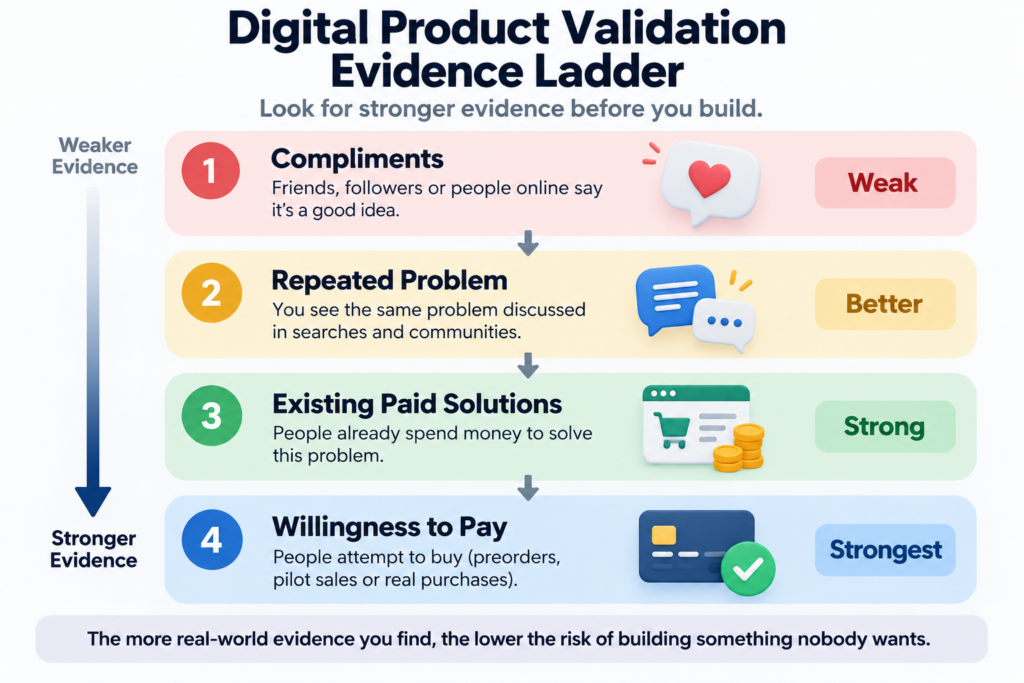
Validation does not mean asking three friends:
“Would you buy this?”
People are generous with encouragement when no money is involved.
Good validation asks whether the problem appears in the real world and whether people already spend time or money solving it.
Look for Search Evidence
Search the problem the way a buyer would describe it.
Check:
- Google results and autocomplete;
- YouTube search suggestions;
- Pinterest;
- marketplace search suggestions;
- relevant questions appearing repeatedly in search results.
You are looking for language and recurring demand—not just one keyword number.
If you use research software to organize this stage, our best AI research tools comparison can help you choose tools for gathering and synthesizing sources. But AI-generated keyword suggestions are only ideas.
They are not proof that people will pay.
Look for Conversation Evidence
Search communities where your buyer talks naturally.
Read:
- Reddit threads;
- niche Facebook groups;
- professional communities;
- forum posts;
- YouTube comments;
- reviews of competing products;
- reviews of software that solves a similar problem.
Pay attention to exact phrases such as:
“I wish there were…”
“How do you keep track of…”
“I made my own spreadsheet because…”
“This tool is good, but I hate…”
Those comments often reveal a product idea far more clearly than a generic list of “50 profitable digital products.”
Do not enter communities just to drop a link.
At this stage, you are listening.
Look for Purchase Evidence
Competition can be useful.
If several products already sell around the problem, the market is telling you something important:
people spend money here.
Then your job becomes differentiation.
Can you make the product:
- narrower;
- easier to use;
- better explained;
- designed for a neglected buyer;
- compatible with a different workflow;
- simpler than the existing option;
- packaged with better examples?
The goal is not necessarily to invent a category nobody has ever seen.
The goal is to give a particular buyer a stronger reason to choose your version.
Test Willingness to Pay Where Practical
The strongest evidence is not a like or survey response.
It is somebody attempting to buy.
Depending on the type of product and how you can responsibly fulfil it, this could mean:
- a small paid pilot;
- a preorder with a clear delivery date;
- an early-access version;
- a minimum viable version sold to a few buyers.
Never take money while hiding the fact that the full product is unfinished.
The purpose is simply to avoid spending a month polishing something before discovering that nobody values the outcome.
A Simple Validation Test Before You Build
Before committing significant time, try to answer yes to most of these:
Can I describe one specific buyer?
Can I find multiple examples of that buyer discussing or searching for the problem?
Can I find existing products, services or manual workarounds solving something similar?
Can I explain why my version deserves to exist?
Do I know at least one realistic place where relevant buyers can be reached?
If you cannot answer the last question, do not rush to build.
You may have a product idea but no distribution plan.
Step 3 — Decide How the First Buyer Will Find You
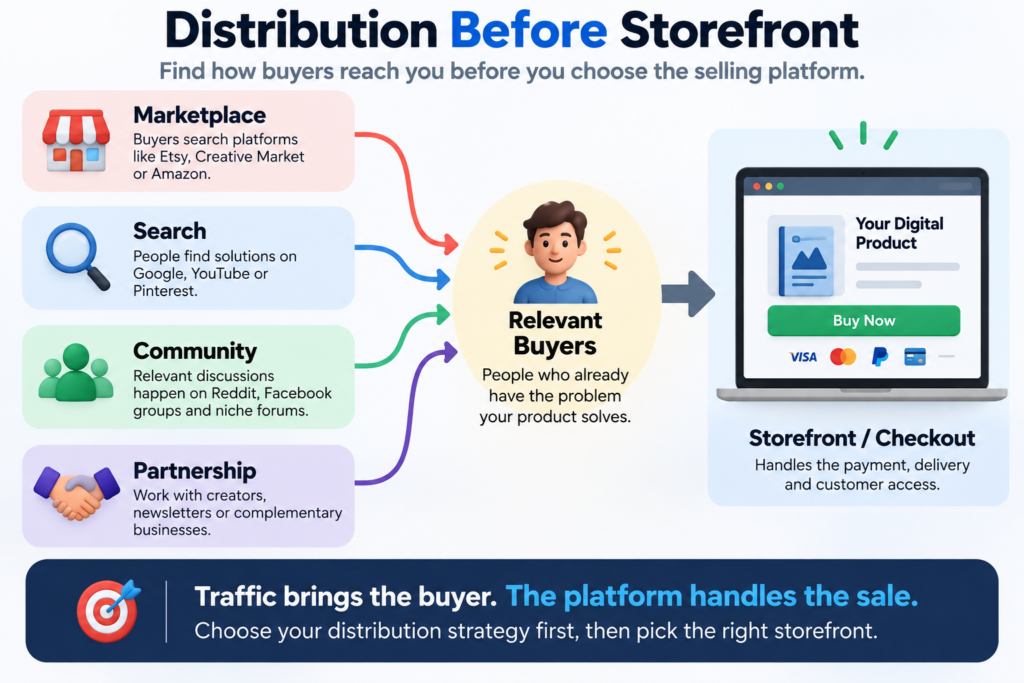
This decision should happen before choosing your storefront.
There are four practical routes for someone trying to sell digital products without followers.
Route 1 — Marketplace Discovery
This works when buyers already search a marketplace for your type of product.
Examples include:
- templates and printables on Etsy;
- design assets on Creative Market;
- ebooks through Amazon KDP;
- certain courses through education marketplaces such as Udemy.
A marketplace gives you access to existing buyer activity.
It does not guarantee ranking or sales.
Your title, keywords, visual presentation, reviews, category fit and competition still matter.
But it can solve part of the distribution problem that a standalone storefront cannot.
Route 2 — Search-Driven Discovery
This works when people actively search for the solution.
Suppose you sell a spreadsheet that calculates freelance project profitability.
Potential discovery channels could include:
- Google;
- YouTube;
- Pinterest;
- niche search content.
Search traffic is particularly valuable because the person is already expressing a need.
A person searching for:
“freelance project profit calculator”
is much closer to a buying problem than a random social-media viewer who happens to see your post.
This route takes work and often takes time, but it can continue bringing relevant visitors long after a social post disappears.
Route 3 — Communities
Communities can work well when the problem is discussed frequently.
The wrong approach is:
join → post product link → disappear.
The better approach is:
understand the conversation → answer useful questions → learn the language → share a relevant resource only where permitted.
This is similar to finding service clients: the problem comes before the pitch. Our guide on how to get your first freelance client with no experience explains the same principle from the freelance-services side.
Community marketing works best when the product naturally belongs in the conversation.
Route 4 — Partnerships and Borrowed Audiences
You can also reach buyers through someone who already has their attention.
That might be:
- a niche newsletter;
- a small YouTube creator;
- an educator;
- a consultant;
- a community owner;
- a complementary business.
You do not necessarily need a celebrity influencer.
A small creator trusted by exactly the right buyers can be more useful than a huge unrelated account.
The partnership might involve an affiliate commission, a bundle, a useful guest resource or another transparent arrangement.
Step 4 — Build the Minimum Useful Product
“Minimum viable” should not mean bad.
It means removing features that do not need to exist yet.
Imagine you want to help freelancers price projects.
Version one could be:
A spreadsheet that calculates project hours, revisions, admin time and target margin + a one-page setup guide.
You do not automatically need:
- a 100-page ebook;
- 30 video lessons;
- a private community;
- five bonuses;
- an app.
Add complexity when customers prove they need it.
A small product that solves one job well gives you faster feedback than a giant product nobody has evaluated yet.
Where Should You Sell Digital Products Online With No Audience?
The best platform to sell digital products depends mainly on where your first customers will come from.
If marketplace discovery is part of the strategy, Etsy may be stronger for the right kind of product.
If you plan to bring traffic yourself, Gumroad or Payhip may be simpler.
If global tax handling, subscriptions or software sales are important, Lemon Squeezy may fit better.
There is no universal winner.
Etsy
Gumroad
Payhip
Lemon Squeezy
Etsy — Strong When Your Product Fits Marketplace Search
Etsy is worth considering for products buyers already expect to search for there:
- printables;
- planners;
- original templates;
- invitations;
- worksheets;
- patterns;
- digital art;
- certain business resources.
Under Etsy’s current rules, digital downloads must be made and/or designed by the seller. Seller-prompted AI creations are also included in the designed-by-a-seller category but must disclose the use of AI.
Etsy currently charges a $0.20 listing fee and a 6.5% transaction fee, with payment-processing and potentially other fees applying depending on the seller and transaction.
Check the current charges in Etsy’s Fees & Payments Policy before publishing or materially updating this section.
Choose Etsy when: the product naturally matches what Etsy buyers search for.
Do not choose Etsy merely because it has traffic: marketplace traffic is only useful when your product, listing and search intent fit that marketplace.
Gumroad — Simple When You Can Bring Relevant Traffic
Gumroad is straightforward for digital files, ebooks, tutorials, memberships and creator products.
There is no monthly platform subscription.
For direct/profile sales, Gumroad currently charges a 10% + $0.50 platform fee, with payment processing charged separately. Sales through Gumroad Discover carry a 30% flat fee that includes processing.
You can verify the current fee structure on Gumroad’s official pricing page.
There is an important limitation for someone starting with no audience and no sales:
Gumroad Discover is not an immediate first-sale traffic source for a brand-new account.
Gumroad currently requires the account to complete its payout setup, reach at least $100 in genuine-sales balance, and pass its risk review before becoming Discover-eligible. An individual product must also have at least one successful sale, a category selected and ratings enabled before it can be listed in Discover.
So a beginner should treat Gumroad primarily as a simple checkout and delivery platform while building an initial traffic source elsewhere.
Gumroad also currently acts as merchant of record for tax handling.
Payhip — Strong Low-Cost Storefront, but Don’t Depend on Its Marketplace for Sale One
Payhip’s Free Forever plan currently costs $0 per month with a 5% transaction fee. Its Plus plan costs $29/month + 2%, while Pro costs $99/month with no Payhip transaction fee. Payment processors still charge their own fees.
You can confirm current plans through Payhip’s official pricing page.
Payhip also has a marketplace, but a store currently needs at least $10 in total previous sales and account review before it can become eligible for marketplace listing. Self-purchases do not count.
That means the marketplace cannot be your full strategy for sale number one.
Payhip is more attractive when you already know how those initial buyers will reach your page.
Payhip also states that, beginning July 1, 2026, it handles US sales-tax collection and payment on sellers’ behalf.
Lemon Squeezy — Strong When Commerce Infrastructure Matters More Than Discovery
Lemon Squeezy is particularly relevant to software, subscriptions and globally sold digital products.
Its current base ecommerce fee is 5% + $0.50 per transaction, although some payments can carry additional fees.
You can verify current pricing through Lemon Squeezy’s official pricing page.
Its attraction is the commerce infrastructure: global payments and automated sales-tax compliance are built into the platform.
The trade-off is straightforward:
Lemon Squeezy can simplify the transaction and compliance side.
You still need to bring the buyer.
Gumroad vs Payhip: Which Is Better for a Beginner?
If you are comparing Gumroad vs Payhip, start with your traffic plan rather than the dashboard design.
Gumroad is attractive for simple creator-focused checkout. Its Discover marketplace can become another discovery source later, but a brand-new zero-sale account cannot depend on Discover for the first sale.
Payhip has a lower platform percentage on its Free plan, but its marketplace also requires previous sales before eligibility.
So:
Choose Gumroad if simplicity matters and you are comfortable with its direct-sale fee structure.
Choose Payhip if you expect to drive your own initial traffic and prefer its storefront economics and features.
Neither platform fixes an unvalidated product.
Step 5 — Create a Product Page That a Stranger Can Trust
Your first buyers do not know you.
That means the page needs to remove uncertainty.
A good product page answers:
Who is it for?
What problem does it solve?
What exactly do I receive?
What does the product look like?
Which app/software/file format does it require?
Can I edit it?
How do I use it?
What am I allowed to do with it?
What is not included?
Compare these two descriptions:
“The ultimate productivity bundle that will transform your workflow.”
versus:
“A Google Sheets content calendar for solo real-estate agents who need to plan four weeks of posts, track approval status and see which posts are ready to publish.”
The second one gives the buyer something concrete to evaluate.
Show the Product, Don’t Just Describe It
Digital products are harder to evaluate than physical products because the buyer cannot pick them up.
Show enough of the product to make the purchase feel real.
Depending on what you sell, that could include:
- screenshots;
- sample pages;
- a short walkthrough;
- an example filled-in template;
- the table of contents;
- a list of included files;
- before/after workflow examples.
Hiding everything may protect the mystery.
It also protects the buyer from understanding why they should pay.
Step 6 — How to Price Digital Products Without Guessing
There is no universal “beginner price.”
Use four inputs.
Comparable alternatives
What do credible competing products cost?
Value of the problem
Saving somebody five minutes once is different from saving a business several hours every month.
Support burden
A downloadable checklist may require almost no support. A complex Notion system may create setup questions.
Platform economics
Fixed fees and percentage fees affect low-priced products more heavily.
You can test price later.
The important mistake to avoid is assuming:
“Nobody knows me, so I need to sell this for $1.”
A lower price cannot make an unwanted product desirable.
And digital-product pricing should not be confused with charging for client services. If you are still selling your time directly, our guide on how much a beginner freelancer should charge explains service pricing separately.
Step 7 — How to Promote Digital Products Without an Audience
Do not start by creating accounts on eight platforms.
Pick one primary distribution channel that matches the buying behavior.
If the Product Fits Marketplace Search
Focus on:
- listing title;
- relevant search terms;
- strong preview images;
- category selection;
- conversion;
- reviews over time.
This is appropriate for products where the marketplace itself contains buyer intent.
If the Product Solves a Searchable Problem
Focus on searchable content.
That might be:
- a useful Google article;
- a YouTube tutorial;
- Pinterest content;
- another format that answers the problem people search before buying.
The content should help the reader first and naturally lead to the paid shortcut.
If the Problem Lives in Communities
Build credibility through useful participation.
Answer the question.
Show the method.
Share the product only when relevant and permitted.
People are much more receptive to:
“Here’s how I solve this.”
than:
“Buy my thing.”
If the Product Needs Trust but You Have No Following
Consider partnerships.
A small trusted creator with a very specific audience may be able to demonstrate the product far better than an ad shown to thousands of cold strangers.
The seller brings the product.
The partner brings relevant trust and attention.
An affiliate arrangement can align the incentives because the partner earns when a referred sale actually happens.
Step 8 — How to Get Your First Digital Product Sale Without Guessing What Is Wrong
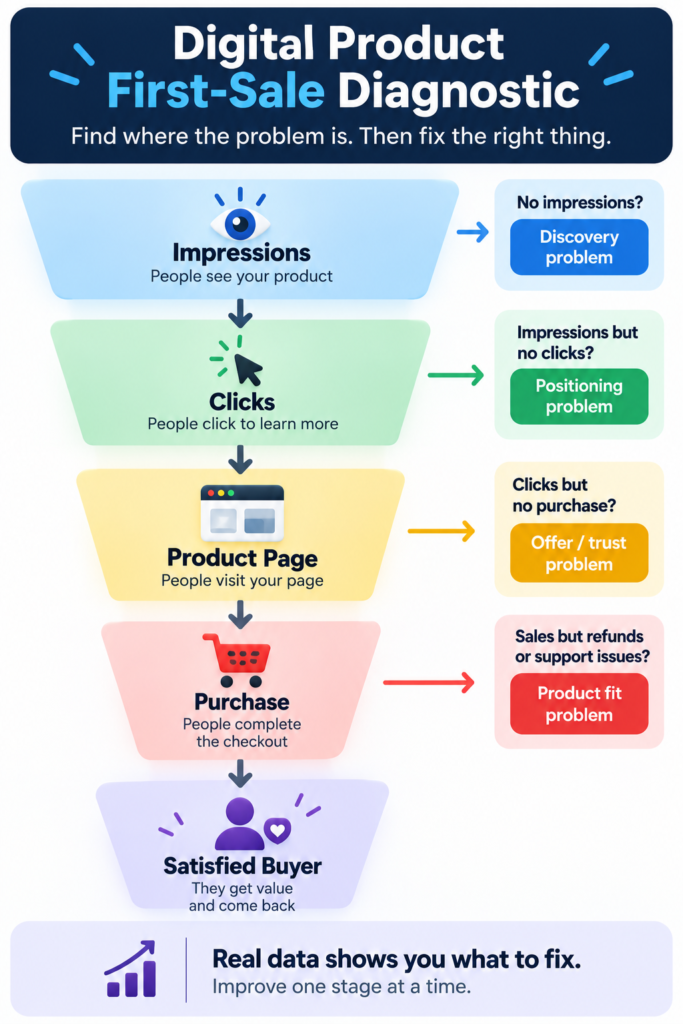
Once people start seeing the offer, stop describing the result simply as:
“sales” or “no sales.”
Look at the stages separately.
You Have Almost No Impressions
This is primarily a discovery problem.
Review:
- channel choice;
- marketplace keywords;
- search demand;
- distribution effort;
- whether you are actually reaching the target buyer.
Do not rewrite the entire product because five people saw it.
You Get Impressions but Very Few Clicks
This is more likely a positioning problem.
Review:
- title;
- thumbnail;
- promise;
- buyer specificity;
- product concept;
- whether the problem looks important enough to investigate.
People saw the option and chose not to learn more.
That is useful evidence.
People Visit the Product Page but Don’t Buy
Now examine the offer.
Possible issues include:
- unclear value;
- poor previews;
- weak trust;
- confusing compatibility;
- price/value mismatch;
- irrelevant traffic;
- checkout friction.
This is where product-page improvements actually matter.
People Buy but Refund or Need Constant Help
Now you may have a product-fit or expectation problem.
Look at:
- product quality;
- instructions;
- setup complexity;
- compatibility;
- promises made on the sales page;
- whether the product solves the problem as described.
This diagnostic is far more useful than switching platforms after every disappointing week.
Do You Need a Website to Sell Digital Products?
No.
You do not need your own website before making a first digital-product sale.
A marketplace listing or hosted product page can be enough to validate the offer.
Your own website becomes more valuable later when you want:
- stronger branding;
- SEO traffic;
- multiple products;
- owned analytics;
- more control over the buying journey;
- an email list and content ecosystem.
Building a full ecommerce website before validating the offer can become expensive procrastination.
For the first test, a clear product page is enough.
Should You Run Paid Ads With No Audience?
You can use advertising without an existing following because you are paying for distribution.
But I would not make paid ads the first answer to an unvalidated product.
Before scaling ads, you need to understand:
Does the offer attract clicks?
Do relevant visitors buy?
How much money remains after platform fees and refunds?
How much can you afford to pay for a customer?
If you keep $12 from a sale and it costs $25 to acquire the buyer, increasing the budget increases the problem.
Use advertising to amplify an offer that has evidence behind it—not to avoid validation.
Can You Sell AI-Generated Digital Products?
Sometimes, but AI does not remove your responsibility for quality, ownership or platform rules.
AI can help with:
- idea expansion;
- research organization;
- draft creation;
- formatting;
- workflow design;
- image concepts;
- examples.
The final product still needs to be:
- useful;
- accurate;
- differentiated;
- legally sellable;
- properly licensed.
Do not assume something is commercially reusable because an AI model produced it or because you found it online.
Etsy, for example, currently allows seller-prompted AI creations within its designed-by-a-seller rules, but requires disclosure of AI use.
Don’t Ignore Licensing, Taxes and Refund Rules
You do not need to become a lawyer before selling a spreadsheet.
But you do need to understand what you are selling.
Ownership:
You need the right to sell the files, designs, fonts, images and other assets included.
Customer license:
Explain whether the buyer can use the product personally, commercially, for one client, for multiple clients, or not redistribute it at all.
Refund policy:
State it clearly and follow applicable law and platform rules.
Tax:
Digital sales can create sales-tax/VAT obligations depending on the transaction and selling model.
Some platforms handle more of this work than others. Gumroad currently operates as merchant of record, Lemon Squeezy provides automated sales-tax compliance, and Payhip now states that it handles US sales tax on sellers’ behalf as well as its existing tax tools.
For tax or legal advice specific to your business and country, use a qualified professional.
A Practical First-Sale Plan
Do not give yourself a fake guarantee such as:
“I must make my first sale in seven days.”
Instead, use milestones.
1. Define one buyer.
Write:
I help [specific person] solve [specific problem].
2. Collect evidence.
Find several independent examples that the problem exists.
3. Identify the distribution route.
Choose marketplace, search, community or partnership.
4. Define the smallest useful solution.
List what the product must include—and what can wait.
5. Build the first version.
Make it good enough that you would be comfortable charging a stranger for it.
6. Create the sales page.
Show the problem, outcome, contents, previews, requirements and terms.
7. Put it in front of relevant people.
Focus on one primary channel.
8. Measure the funnel.
Track:
Impressions → clicks → product-page visits → purchase → refund/support
9. Fix the weakest stage.
Do not rebuild everything at once.
That gives you a repeatable process instead of another guessing game.
Frequently Asked Questions
Can you sell digital products without followers?
Yes.
You can sell digital products without followers by reaching buyers through marketplace search, search engines, communities, partnerships or paid traffic.
An existing following is one distribution advantage, not a requirement for making the first sale.
What is the best digital product to sell with no audience?
There is no single best product.
A strong first product solves a specific problem for an identifiable buyer, is easy to demonstrate, and has a realistic distribution channel.
A narrow spreadsheet or template can therefore be a better first product than a huge generic course.
Where should a beginner sell digital products?
Use the buyer’s discovery path to decide.
Etsy is attractive when marketplace search already exists for the product type.
Gumroad and Payhip are attractive when you can bring initial traffic yourself.
Lemon Squeezy is stronger when global digital commerce, subscriptions, software or merchant-of-record infrastructure matters.
Is Gumroad good for beginners?
Yes, Gumroad can be simple for beginners to set up and use.
The important limitation is that simplicity of checkout is not the same as guaranteed traffic.
And a brand-new account cannot rely on Gumroad Discover for its first sale because Discover has account- and product-level eligibility requirements.
A beginner still needs a product people want and a way to get the initial relevant buyers to the page.
Gumroad vs Payhip: which is better?
Gumroad is particularly simple for direct creator sales and can add Discover later once you qualify.
Payhip’s Free plan has a lower platform percentage, but its marketplace also requires previous sales before eligibility.
If you’re bringing your own first visitors, Payhip may be attractive.
If you prefer Gumroad’s ecosystem and accept its fee structure, Gumroad may be simpler.
Do you need an email list before selling a digital product?
No.
An email list becomes extremely useful as the business grows because you can reach previous visitors and customers again.
But it is not a prerequisite for testing a first product.
How long does it take to get your first digital product sale?
There is no reliable universal timeline.
A product with clear existing demand and marketplace visibility can make a sale quickly.
Another product may take weeks or months of testing before the seller understands the positioning or traffic source.
Treat claims such as “everyone can make a sale in 24 hours” as marketing, not a dependable benchmark.
Final Takeaway
Learning how to sell digital products online is not mainly about finding the perfect storefront.
And learning how to sell digital products with no audience does not mean discovering a secret platform that sends guaranteed buyers.
It means building the first pieces of the business in the right order:
Find a real problem.
Look for evidence that people care.
Create a focused solution.
Know where the first buyers can be reached.
Choose a storefront that supports that distribution path.
Make the product easy for a stranger to understand and trust.
Then use real visitor behavior to decide what needs improving.
Your first sale matters because somebody who did not have to pay decided the solution was worth money.
That is the first useful proof.
The next goal is not to immediately build ten more products.
It is to understand why that person bought—and make the system easier for the next right buyer to find.