Getting your first freelance client can feel much harder than learning the skill you’re trying to sell.
You might know how to design websites, write articles, edit videos, manage social media, build WordPress sites or analyze data. But knowing how to do the work and knowing where to find people willing to pay for it are two very different problems.
Upwork and Fiverr can help freelancers get started, but they aren’t the only places where clients exist. In fact, building some client-acquisition channels outside these marketplaces can give you more control over your pricing, relationships and future work.
That doesn’t mean you should immediately abandon freelance platforms. It means you shouldn’t depend on them completely.
In this guide, we’ll look at practical ways to find freelance clients without relying on Upwork or Fiverr, including referrals, LinkedIn, cold email, partnerships, online communities, local businesses and your own website.
The goal isn’t to send hundreds of random messages and hope somebody responds. It’s to build a repeatable system that puts your work in front of people who have a genuine reason to hire you.
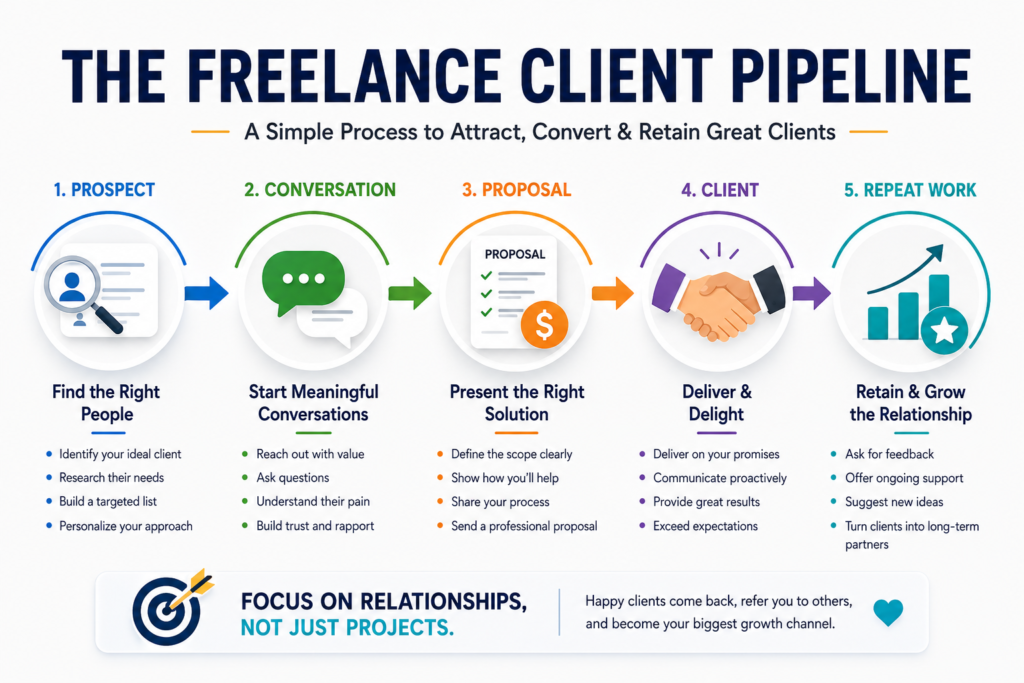
Table of Contents
Why Look for Freelance Clients Outside Upwork and Fiverr?
Freelance marketplaces solve an important problem: they bring clients and freelancers together in one place.
The downside is that you’re competing inside someone else’s marketplace.
Your profile is competing against thousands of other freelancers. Your visibility can depend on the platform’s search and recommendation systems, and fees can reduce what you ultimately keep from a project. Upwork’s current freelancer service fee ranges from 0% to 15% depending on the contract.
There’s another problem that becomes obvious when you’re trying to get your first few clients: competition is not theoretical.
Recent discussions from freelancers in 2026 repeatedly mention the difficulty of standing out on Upwork and Fiverr and the growing interest in referrals, direct outreach, agency relationships and other channels.
Finding clients directly can therefore give you several advantages:
- You can build a relationship directly with the client.
- You aren’t relying entirely on a marketplace algorithm.
- You can develop your own reputation and brand.
- You have more control over how you present your services.
- A satisfied client can potentially refer you to someone else.
- You can build a pipeline instead of starting from zero every time you need work.
But there’s an important trade-off.
When you leave a marketplace, you also lose some of the infrastructure it provides. You have to find prospects, establish trust, communicate professionally, agree on scope, handle contracts and arrange payment yourself.
That’s why the goal isn’t simply to replace Upwork with cold emails.
The goal is to build a client-acquisition system that you control.
The Best Ways to Find Freelance Clients Without Upwork or Fiverr
There isn’t one secret website where clients are waiting for beginners.
Instead, successful freelancers tend to combine a few channels that fit their particular skill and target market.
The main options we’ll examine are:
- Referrals and personal networks
- Cold email
- Partnerships with agencies and other freelancers
- Online communities
- Local businesses
- Your own website and content
You don’t need to use all seven.
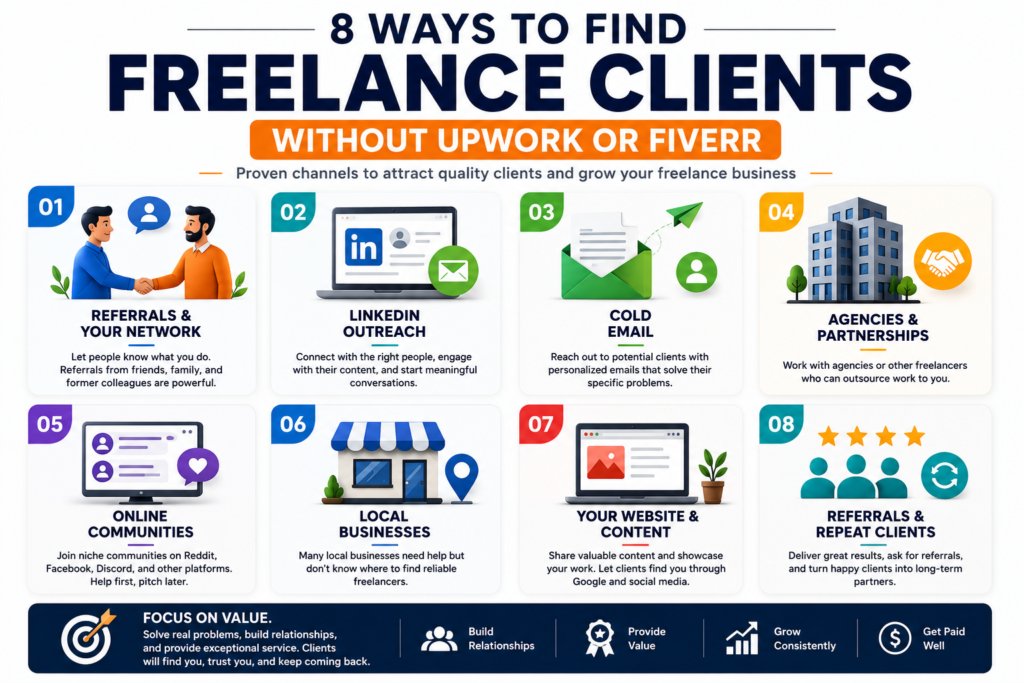
For a beginner, one well-chosen channel used consistently is usually more useful than seven channels used badly.
1. Start With People You Already Know
When you’re starting freelancing, it’s tempting to look for strangers who might hire you.
Sometimes the easiest place to start is much closer.
Think about former coworkers, classmates, friends, relatives, previous employers, local business owners, online contacts, and people you’ve worked with before. You don’t need to ask all of them to become your clients. You simply need to let the right people know what you do and who you can help.
This works because a warm introduction starts with some level of trust. Recent freelancer-focused research and community discussions continue to put referrals and existing relationships among the more valuable sources of new work.
Don’t Send a “Please Give Me Work” Message
A weak message sounds like:
“Hi, I’m a freelancer. Please let me know if you have any work.”
It puts all the effort on the other person to figure out what you can actually do.
Instead, make the message specific.
For example, a freelance graphic designer could say:
“I’ve started offering landing-page design for small businesses. If you know a business owner who needs help improving their website, I’d be happy to take a look and let them know what I’d recommend.”
That’s much easier to understand.
You’re not begging for work. You’re explaining what you offer and who you’re useful to.
2. Use LinkedIn to Find People, Not Just Jobs
LinkedIn can be useful for freelancers because you’re able to identify both businesses and the people behind them.
You don’t have to wait for someone to post a freelance job.
Suppose you’re a freelance copywriter who specializes in SaaS companies.
Instead of searching:
“copywriting freelance jobs”
you could search for:
- SaaS founders
- startup marketing managers
- heads of marketing
- content managers
- agencies working with SaaS companies
Now you’re looking for potential buyers, rather than competing with hundreds of freelancers applying for the same job.
Recent 2026 freelancer guides continue to emphasize this combination of a clear profile, targeted outreach and useful content rather than treating LinkedIn simply as a job board.
Make Your Profile Explain What You Do
Before contacting anyone, make sure your profile answers three questions quickly:
What do you do?
Who do you do it for?
What result can you help them achieve?
Compare:
“Freelance Writer | Content Creator | Digital Marketing”
with:
“I help SaaS companies turn complex products into clear, search-friendly content.”
The second version gives a potential client a much better reason to continue reading.
Don’t Pitch Immediately
One of the easiest ways to make LinkedIn outreach feel like spam is sending a sales pitch immediately after someone accepts your connection.
Start like a human.
Interact with their content when you genuinely have something useful to add. Understand what the company does. Look for a real problem you can solve.
Then, when there is a legitimate reason to start a conversation, keep the message short and specific.
That matters because people are increasingly overwhelmed by generic LinkedIn outreach. Recent reporting also shows that concise, personalized messages can stand out precisely because most unsolicited messages are ignored.
3. Find Businesses That Already Need Your Skill
This is where freelancing becomes less about “finding freelance jobs” and more about finding problems that businesses already have.
A business may never advertise:
“We need a freelance website designer.”
But you might discover that its website is outdated, its product descriptions are poor, its social media hasn’t been updated, or its blog hasn’t published anything in months.
Those are potential opportunities.
For example:
Web designer: Find businesses with outdated websites.
Copywriter: Find companies with weak product pages or inconsistent website copy.
Video editor: Find creators and businesses already publishing videos but doing so inconsistently.
Bookkeeper: Find small businesses that are growing but don’t appear to have dedicated bookkeeping support.
The important distinction is this:
Don’t manufacture a problem just so you can sell a service.
Find an actual problem first.
Then explain how you could help.
4. Use Cold Email Carefully
Cold email can work, but it is probably the most abused piece of freelance advice online.
The problem isn’t necessarily cold email itself.
It’s the generic mass email.
A message like:
“Dear Sir/Madam, I am a professional digital marketer and would love to help your company grow. Please let me know if interested.”
is incredibly easy to ignore.
A better approach is to research the company first.
For example:
Subject: Small idea for [Company]
Hi Sarah,
I noticed your company recently launched [specific product/service]. I also noticed the product page doesn’t currently explain [specific issue].
I work with SaaS companies on website copy, and I have a couple of ideas that could make that section clearer for potential customers.
Happy to send them over if useful.
— [Name]
Notice what isn’t there:
- no giant introduction
- no list of 15 services
- no fake urgency
- no “I guarantee results”
- no enormous portfolio dump
You’re starting a conversation.
Current 2026 discussions from freelancers and agencies show that cold outreach is still being used, but also emphasize targeting, relevance and deliverability rather than simply sending huge numbers of emails.
Quality Matters More Than Sending Hundreds of Messages
If you’re sending cold email, don’t begin by thinking:
“How many emails can I send today?”
Think:
“How many genuinely suitable businesses can I identify today?”
Ten carefully researched prospects can be more valuable than a hundred generic messages.
And never buy random email lists or send unsolicited bulk messages without understanding the applicable rules. Your goal is to build a client pipeline—not create a spam problem.
5. Partner With Agencies and Other Freelancers
You don’t always need to find the client yourself.
Sometimes the fastest way to get freelance work is to become the person another professional can call when they have more work than they can handle.
For example:
- A web designer may need a copywriter.
- A marketing agency may need a video editor.
- A developer may need a UI designer.
- A photographer may need someone to edit images.
- A social-media manager may need a freelance writer.
- A consultant may need someone to prepare reports or presentations.
This arrangement can be particularly useful for beginners because the agency or freelancer has already done part of the trust-building with the client.
Current freelance-client research continues to identify agency and consultant partnerships as an important acquisition channel.
How to Find Potential Partners
Don’t contact every agency you can find.
Look for businesses whose services complement yours.
For example, if you’re a freelance WordPress developer, search for:
“digital marketing agency + [city]”
“SEO agency + [city]”
“branding agency + [city]”
Then look at their services and client base.
If you notice they regularly offer services that overlap with yours but don’t appear to have that capability internally, they may be worth contacting.
What to Say
Keep the message simple:
Hi John,
I came across your agency while looking at businesses working with small e-commerce brands. I noticed you offer SEO and marketing services but don’t appear to list WordPress development.
I’m a freelance WordPress developer and occasionally work as a white-label partner for agencies.
If you ever need an extra developer for client projects, I’d be happy to send over some examples of my work.
Best,
[Name]
You’re not asking them to give you a job.
You’re offering to become useful when they need additional capacity.
6. Look for Clients Inside Niche Communities
Online communities can work surprisingly well when you choose the right ones.
The mistake is joining dozens of groups and immediately posting:
“I’m a freelancer available for work. DM me.”
That usually looks like advertising.
Instead, find communities where your potential clients already discuss problems.
For example:
| Your skill | Communities to explore |
| Web development | Startup, SaaS and small-business communities |
| Writing | Marketing and founder communities |
| Design | Startup, ecommerce and creator communities |
| Video editing | YouTube and creator communities |
| SEO | Business and marketing communities |
| Presentation design | Startup and sales communities |
Current 2026 research and freelancer discussions continue to point toward niche Reddit, Discord, Slack, LinkedIn and industry communities as places where people actively ask for recommendations or help.
Watch for Buying Signals
Don’t just look for posts saying:
“I need a freelancer.”
Look for posts describing a problem.
For example:
“Our website conversion rate is terrible.”
A web designer or conversion specialist might have an opportunity.
Or:
“We need to publish two blog posts every week but don’t have time.”
That’s a potential content-writing opportunity.
The key is help first, pitch second.
If the community allows recommendations or direct offers, respond specifically to the problem. If it doesn’t, follow the community rules rather than turning every discussion into a sales pitch.
7. Approach Local Businesses Directly
This is one of the most overlooked options for freelancers.
You don’t have to find every client in the United States or another country.
A local business can become a valuable first client, particularly for services such as:
- Website development
- Graphic design
- Social media management
- Photography
- Video editing
- SEO
- Copywriting
- Bookkeeping
One practical method is to search Google Maps for businesses in a specific niche and location, then look for obvious gaps in their online presence.
For example:
“dentists in Chicago”
“restaurants in Houston”
“real estate agents in Dallas”
Then examine their websites, Google profiles and social accounts.
A business with a genuinely outdated website or weak online presence may be a better prospect than a random business you’ve never researched.
Recent freelancer discussions specifically mention direct outreach to local businesses as an alternative to competing on Upwork and Fiverr.
Don’t Send a Generic Sales Pitch
Instead of:
“We provide professional website design services at affordable prices.”
Try:
“Hi Mike, I came across your restaurant while searching for Italian restaurants in Austin. I noticed your menu is difficult to access from mobile and the booking button is quite hard to find. I build simple websites for local businesses and noticed a couple of changes that could make the site easier for customers to use.”
The second message gives the business owner a reason to care.
8. Build a Referral System
Referrals become more powerful once you’ve completed a few projects.
The mistake is waiting for referrals to happen automatically.
After delivering good work, simply ask.
For example:
“I’m glad you’re happy with the project. If you know another business owner who could use similar help, I’d really appreciate an introduction.”
That’s enough.
You don’t need a complicated referral program when you’re starting out.
A happy client already understands your work, knows how you communicate and has experienced the result. That makes their recommendation much more valuable than a completely cold lead.
Current freelance resources consistently identify referrals as one of the strongest sources of new business.
Turn One Client Into More Than One Project
Don’t disappear immediately after completing the work.
A client who hired you for one service may eventually need another.
A website client might later need:
- Website maintenance
- SEO
- Blog content
- Landing pages
- Social media graphics
- Analytics setup
The goal isn’t to constantly sell to the client.
It’s to remain useful and easy to contact.
Whichever platform you choose, clients will still want evidence that you can do the work. If you’re starting without previous clients, build a few relevant samples and create a beginner freelance portfolio before sending large numbers of proposals.
Choosing the Right Client-Acquisition Channel
One mistake beginners make is trying everything at once.
They create a LinkedIn account, start cold emailing, join Facebook groups, post on Reddit, build a website, attend networking events and send proposals—all while still trying to finish their actual client work.
That quickly becomes another full-time job.
A better approach is to choose two channels that fit your situation and give them enough time to produce useful feedback. A recent 2026 freelancer client-acquisition analysis similarly recommends focusing on only a few channels rather than spreading yourself across every option.
If You Have No Network
Start with:
LinkedIn + targeted outreach
You can build a network while simultaneously approaching businesses that fit your service.
Don’t worry about having thousands of connections. A small network of relevant people is more useful than a large audience that has nothing to do with your work.
If You Already Have Happy Clients
Start with:
Referrals + partnerships
A previous client can introduce you to someone who already trusts their recommendation. Similarly, agencies and other freelancers can send work your way when they need additional help.
If You’re Comfortable With Research
Try:
Cold email + LinkedIn
This combination works particularly well when your service solves an identifiable business problem.
For example, instead of emailing every restaurant in a city, a web designer could specifically target restaurants whose websites have obvious usability problems.
If You’re a Content Creator
Consider:
Content + LinkedIn or your own website
This is slower than direct outreach, but useful content can demonstrate your expertise before a potential client ever contacts you.
It’s also an asset you own rather than something completely dependent on a marketplace.
Don’t Try to Replace Upwork or Fiverr Overnight
There is an important distinction between using a marketplace and depending on a marketplace.
If Upwork or Fiverr currently brings you work, there’s no reason to delete your account simply because you’re building another client channel.
Instead, gradually diversify.
For example:
Month 1: Marketplace + LinkedIn
Month 2: Marketplace + LinkedIn + referrals
Month 3: Marketplace + direct outreach + referrals
Over time, the goal is for your marketplace account to become one source of leads rather than your entire business.
That distinction matters because off-platform client acquisition requires you to replace several things marketplaces normally provide: visibility, trust signals, communication infrastructure, payment processes and sometimes dispute protection.
A Simple Weekly Client-Finding Routine
You don’t need to spend eight hours every day looking for clients.
A beginner could start with something like this:
| Activity | Weekly target |
| Research potential clients | 20 |
| Personalized outreach | 15–20 |
| LinkedIn conversations | 10 |
| Follow-ups | 10 |
| Helpful community interactions | 5 |
| Referral requests | 2–3 |
These aren’t magic numbers. They’re simply enough activity to create consistent feedback without turning client acquisition into your entire working week.
The important part is tracking what happens.
If you contact 50 carefully selected businesses and nobody responds, don’t simply send another 500 messages.
Ask:
- Am I targeting the right businesses?
- Is my offer clear?
- Does the problem I’m identifying actually matter?
- Is my portfolio relevant?
- Is my message too generic?
- Am I contacting the right person?
- Am I following up appropriately?
Client acquisition improves through iteration, not blind volume.
What Beginners Usually Get Wrong
Trying to Sell Everything
“Web design + SEO + social media + video editing + AI + marketing + graphic design” doesn’t create a strong position.
A potential client should understand quickly what you do and why you’re relevant to them.
Contacting People Without Research
If you don’t know what the business does, your message will probably sound generic.
Spend a few minutes understanding the prospect before contacting them.
Expecting an Immediate Response
Direct client acquisition is not an ATM.
You may send messages this week and receive your first serious conversation weeks later. Current 2026 freelancer guides similarly emphasize that building a predictable pipeline takes time and repeated activity.
Giving Up After Ten Messages
Ten messages aren’t enough to tell you whether a strategy works.
At the same time, sending 1,000 identical messages isn’t a strategy either.
Look at the quality of your prospects and your response data and improve from there.
Using AI to Send Generic Spam
AI can help you research companies, organize prospects and improve a draft.
It shouldn’t turn one generic message into 500 slightly different generic messages.
There’s also a growing conversation around transparency and client expectations when freelancers use AI in their work. A 2026 academic study found a significant gap between how freelancers and clients perceive AI disclosure, reinforcing the importance of clear expectations when AI is involved.
The Goal Isn’t More Leads. It’s Better Leads.
You don’t need hundreds of clients.
A freelancer with five good recurring clients may have a much healthier business than someone constantly chasing dozens of tiny projects.
That’s why finding clients outside Upwork and Fiverr isn’t really about escaping marketplaces.
It’s about building relationships you can keep.
A client who hires you directly can potentially:
- hire you again,
- increase the scope of work,
- introduce you to another business,
- recommend you to a colleague,
- or become a long-term retainer client.
That is the real advantage of building your own client pipeline.
A Practical 7-Day Plan to Get Your First Direct Client
If you’re starting from zero, don’t try every method in this article at the same time.
Use the first week to build a small, repeatable system.
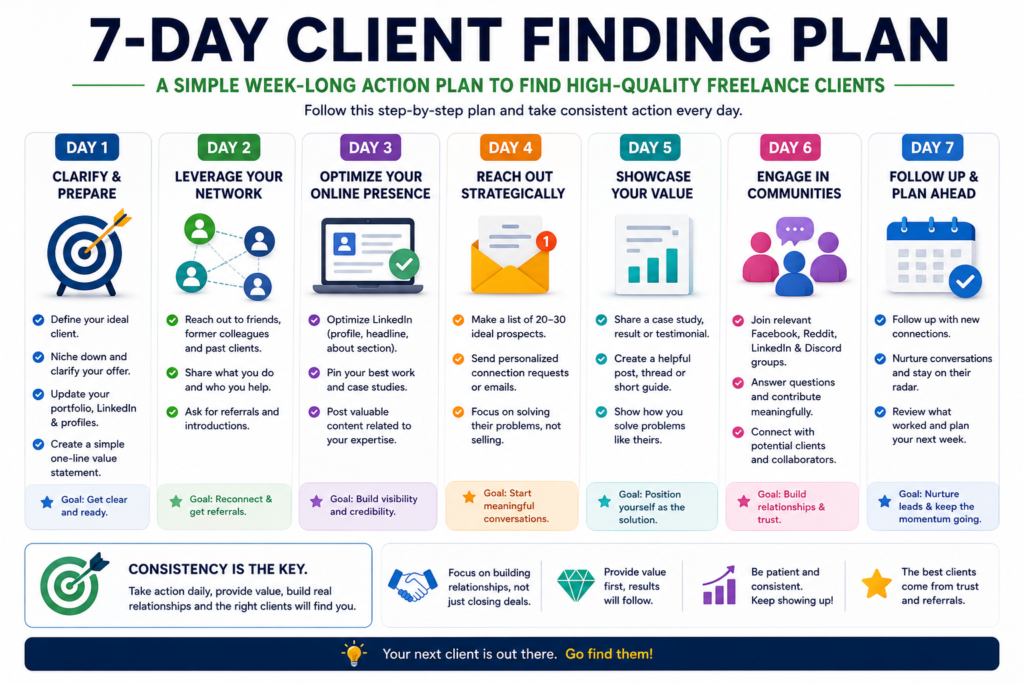
Day 1: Choose One Service and One Client Type
Don’t start with:
“I can do anything related to digital marketing.”
Choose something specific.
For example:
“I create short-form videos for real-estate agents.”
or:
“I build simple WordPress websites for local restaurants.”
The narrower your initial offer, the easier it becomes to identify potential clients and explain why they should talk to you.
Day 2: Prepare Three Samples
You don’t necessarily need years of experience.
If you have no client work, create three relevant sample projects.
For example, a beginner copywriter could create:
- a sample landing page,
- a product description,
- a short email campaign.
Be honest that they’re sample projects. Don’t present practice work as paid client work.
Day 3: Build a Prospect List
Find around 20 businesses or people who could genuinely benefit from your service.
Record:
- Name
- Company
- Website
- Contact person
- Contact method
- Problem you noticed
- Date contacted
- Response
- Follow-up date
You can start with a simple spreadsheet. You don’t need expensive CRM software on day one.
Day 4: Send Personalized Outreach
Contact a small number of highly relevant prospects.
Each message should answer:
Why them?
Why you?
Why now?
Keep it short.
The objective isn’t to close a $2,000 project from the first message.
The objective is to start a conversation.
Day 5: Follow Up
Many beginners send one message and immediately assume the person isn’t interested.
A polite follow-up can be worthwhile, particularly when your first message was genuinely relevant.
Don’t send:
“Just following up.”
Instead, add something useful:
“I had another look at your landing page and noticed one additional issue with the mobile version. I can send you the two suggestions if you’d like.”
Now you’re giving the person a reason to respond.
Day 6: Use a Second Channel
If you were using cold email, try LinkedIn.
If you were using LinkedIn, try referrals.
If you were contacting businesses directly, look for relevant communities.
You’re testing channels—not desperately increasing volume.
Day 7: Review the Numbers
At the end of the week, look at:
- prospects researched,
- messages sent,
- replies,
- conversations,
- calls,
- proposals,
- projects won.
Don’t judge the strategy only by whether you got paid in seven days.
You’re looking for where the process breaks.
If nobody replies, improve targeting or messaging.
If people reply but don’t book calls, improve your offer.
If people book calls but don’t buy, examine your pricing, portfolio and sales process.
What If Nobody Responds?
This is where many beginners make the wrong decision.
They conclude:
“Freelancing doesn’t work.”
But silence doesn’t tell you why you’re getting no clients.
There are several possibilities.
Your target market is wrong
You may be offering a service to businesses that don’t need it.
Your offer is too vague
“Digital marketing services” is difficult to evaluate.
“Google Business Profile optimization for local dentists” is much clearer.
Your portfolio doesn’t prove the right skill
A potential client shouldn’t have to guess whether your previous work is relevant.
You’re contacting the wrong person
A small business owner may be the right contact. At a larger company, a marketing manager or department head may be more appropriate.
Your outreach sounds automated
This is increasingly important.
People are receiving enormous numbers of generic AI-written messages. Recent reporting on professional outreach has highlighted how concise, specific and human messages can stand out from the flood of generic communication.
AI can help you research prospects or improve your draft, but your message should still sound like something a real person would send.
The Long-Term Goal: Build a Client Pipeline You Own
Getting one client is great.
Getting a system that can repeatedly produce conversations is much more valuable.
Over time, your client acquisition system can look like this:
Content / referrals / LinkedIn / outreach
↓
Potential client
↓
Conversation
↓
Discovery call
↓
Proposal
↓
Paid project
↓
Good result
↓
Repeat work / referral
That final stage is where freelancing becomes much more sustainable.
You stop starting from zero every month.
And this is ultimately why finding clients outside Upwork or Fiverr matters. You’re not simply looking for a different website where you can apply for jobs. You’re building relationships, reputation and a pipeline that belongs to you.
Frequently Asked Questions
Can I get freelance clients without Upwork or Fiverr?
Yes. Freelancers can find clients through referrals, LinkedIn, direct outreach, agencies, niche communities, local businesses, networking and their own content or websites. The challenge is that you have to create the lead-generation and trust-building process yourself.
What is the best way for a beginner to find freelance clients?
There isn’t one universal method. If you already have a network, referrals may be the easiest starting point. If you don’t, targeted LinkedIn outreach, direct outreach and relevant communities can help you create opportunities.
Do I need experience to get freelance clients?
You don’t necessarily need previous paid clients, but you do need evidence that you can perform the work. Three strong, relevant sample projects are more useful than a portfolio filled with unrelated work.
Should I stop using Upwork and Fiverr?
Not necessarily. If a marketplace is already producing work for you, there’s little reason to abandon it immediately. The better goal is diversification: gradually develop direct sources of clients so that one platform doesn’t control your entire pipeline.
How many potential clients should I contact each day?
There is no magic number. Start with a manageable number that allows you to research and personalize each prospect. Quality matters more than sending hundreds of identical messages.
Is cold email still effective for freelancers?
It can be, but generic mass outreach is increasingly difficult to distinguish from spam. Targeted messages based on a real business need are much more sensible than sending the same pitch to hundreds of companies.
Final Takeaway
You don’t need Upwork or Fiverr to become a freelancer.
But you do need to replace what those platforms provide: visibility, trust, lead generation and a convenient way to connect with buyers.
The difference is that when you find clients directly, you gradually build those assets yourself.
Start small.
Choose one service. Pick a specific type of client. Create a few strong samples. Find businesses that genuinely need your help. Start conversations instead of blasting sales pitches. Follow up professionally, measure what happens and improve the process.
Your first client may come from a friend.
Your second might come from LinkedIn.
Your third could come from an agency.
Another might come from a referral.
There isn’t one correct path.
The important thing is to stop thinking that freelancing means waiting for someone to post a job.
You can actively go where potential clients already are, identify problems you can solve, and build relationships directly.
That is the foundation of a freelance business you control.