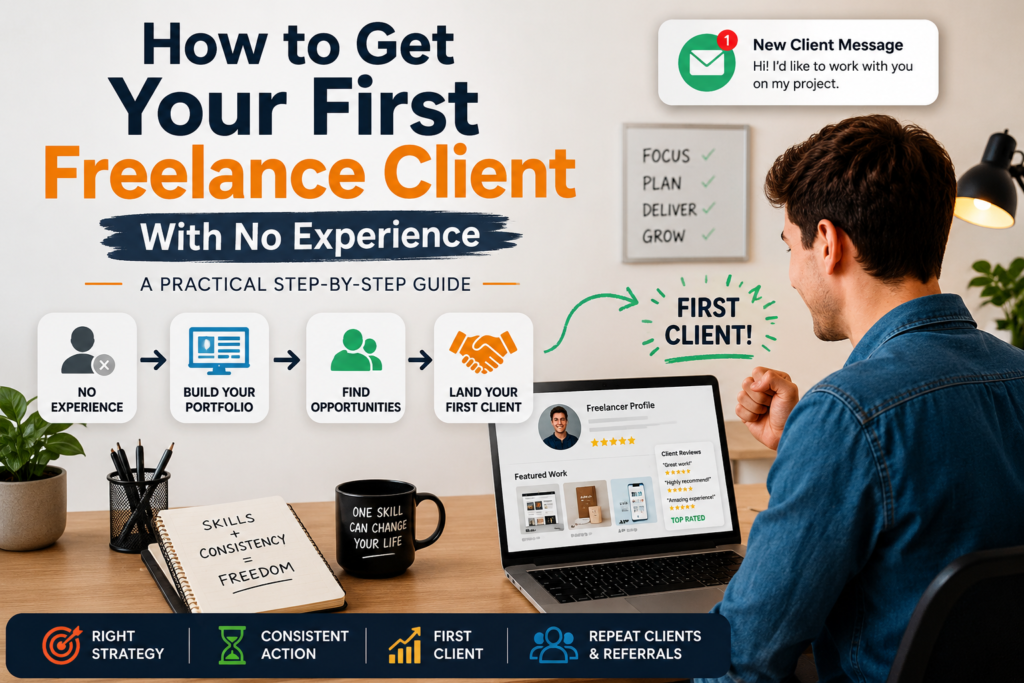
You find a freelance job that actually looks achievable.
The client needs a blog writer, designer, video editor, virtual assistant, developer—or whatever service you’ve been learning. You read the requirements and think, I could do this.
Then comes the uncomfortable part:
“Please send examples of your previous work.”
You haven’t had a client yet.
So what exactly are you supposed to send?
This is where many beginners get stuck. They assume a freelance portfolio is a record of people who have already paid them. It isn’t.
A portfolio is evidence of what you can do.
If you haven’t been paid for your skills yet, you can create that evidence yourself through carefully chosen sample projects, personal work, concept projects, or genuine volunteer work.
The important part is not pretending that a practice project came from a real client. The important part is making the work relevant enough that a potential client can look at it and think:
“This person could probably do something similar for me.”
This guide will show you how to build that kind of freelance portfolio from scratch.
Table of Contents
Can You Create a Freelance Portfolio With No Experience?
Yes.
You don’t need paid client work to start building a freelance portfolio.
What you do need is something a client can evaluate.
For example, if you’re offering blog writing, saying “I’m a good writer” isn’t very persuasive. A well-written article in the client’s industry is evidence.
If you’re offering social media design, saying “I know Canva” matters less than showing a polished set of posts you created for a realistic business brief.
This distinction matters:
Experience is history. A portfolio is proof.
Eventually, real client projects, testimonials and measurable results can make that proof stronger. But they don’t have to be where your portfolio begins.
Even major freelance platforms treat portfolio work as a way to demonstrate skills. Upwork’s portfolio guidance recommends being selective and showing your best work rather than everything you’ve created; portfolio entries can include images, video, audio, documents and external links.
Your first portfolio therefore doesn’t need 15 projects.
Three relevant, well-presented samples can be far more useful than a large collection of unrelated work.
How to Create a Freelance Portfolio With No Experience: 7 Steps
The easiest way to avoid getting overwhelmed is to build the portfolio in the right order.
Don’t start by choosing colors, buying a domain or designing a fancy homepage.
Start with the work you want someone to hire you to do.
Step 1: Choose the Service You Want Your Portfolio to Sell
A common beginner mistake is trying to prove everything at once.
You might know some writing, Canva, WordPress, SEO and video editing. That doesn’t mean all five belong in the same starter portfolio.
Ask yourself:
What service do I want someone to pay me for first?
If the answer is blog writing, build a writing portfolio.
If it’s short-form video editing, show edited videos.
If it’s WordPress development, show websites.
This sounds obvious, but it changes how a potential client understands you.
Compare:
“Here are some things I’ve made.”
with:
“Here are examples of the exact type of work you’re considering hiring me to do.”
The second portfolio reduces the amount of imagination required from the client.
If you haven’t decided where you want to sell that service yet, our best freelancing platforms for beginners can help you compare beginner-friendly places to look for freelance work.
Step 2: Picture the Client You Want to Attract
You don’t need an elaborate “ideal customer avatar.”
You just need enough direction to make your samples realistic.
Suppose you’re a writer.
“Writing samples” could mean almost anything.
But if you want to write for productivity and SaaS businesses, you could create:
- a how-to article for a fictional productivity app;
- a comparison-style article;
- an onboarding email sequence.
A designer targeting restaurants could create a menu redesign, promotional social posts and a simple landing-page concept.
The point is simple:
Build samples for the work you want—not random exercises that happen to use the same skill.
This is one of the easiest ways for a beginner portfolio to feel more intentional.
Step 3: Create 2–4 Strong Sample Projects
This is the step that replaces the missing client history.
There are several legitimate ways to create portfolio work before you’ve been hired.
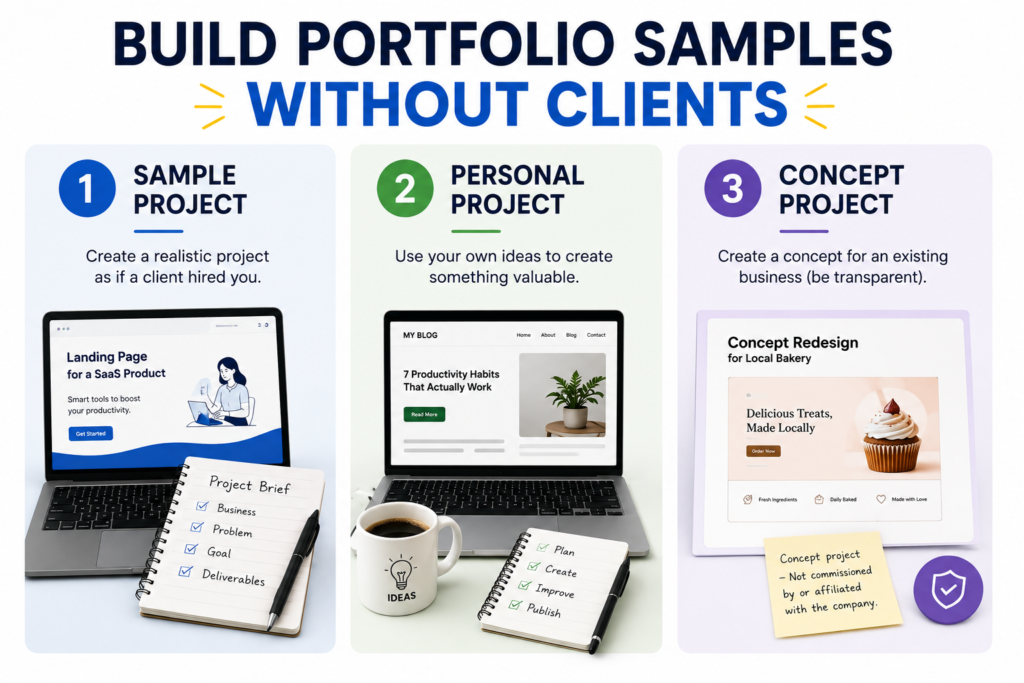
Create a realistic sample project
Write yourself a simple brief as though a client had contacted you.
For example:
Business: fictional meal-prep company
Problem: visitors don’t understand the weekly subscription
Task: create a clear landing page
Deliverable: desktop and mobile landing-page concept
Then complete the project properly.
Don’t create something deliberately easy just so you can say you have a portfolio piece. Your sample should represent work you’d genuinely be comfortable delivering to a paying client.
Use a personal project
Sometimes you already have useful proof.
A developer might build their own portfolio website.
A writer may have a personal article worth polishing.
A video editor could turn their own footage into a professional short.
A virtual assistant might create a project-management dashboard demonstrating how they would organize a client’s workflow.
The question isn’t “Was somebody paying me?”
It’s:
“Does this demonstrate the skill I’m selling?”
Create concept work carefully
You can also create an unsolicited concept for an existing business—for example, redesigning a landing page or rewriting a headline.
But be transparent.
Don’t put a recognizable company into your portfolio in a way that suggests they hired or endorsed you when they didn’t.
Label it clearly:
Concept project — not commissioned by or affiliated with the company.
That gives clients the context they need without weakening the work itself.
What Should a Beginner Put in a Freelance Portfolio?
A beginner portfolio doesn’t need to look like an agency website.
At minimum, a client should quickly understand:
- what service you provide;
- who you help;
- what your work looks like;
- what problem each sample was designed to solve;
- what you actually did;
- how to contact you.
The work should remain the focus.
Contra’s portfolio guidance similarly recommends showing services and selecting strong projects that demonstrate expertise rather than treating a portfolio as an archive of everything you’ve done.
That brings us to an important difference between a sample and a portfolio piece.
A sample is the deliverable.
A portfolio piece explains enough context for someone to understand why that deliverable matters.
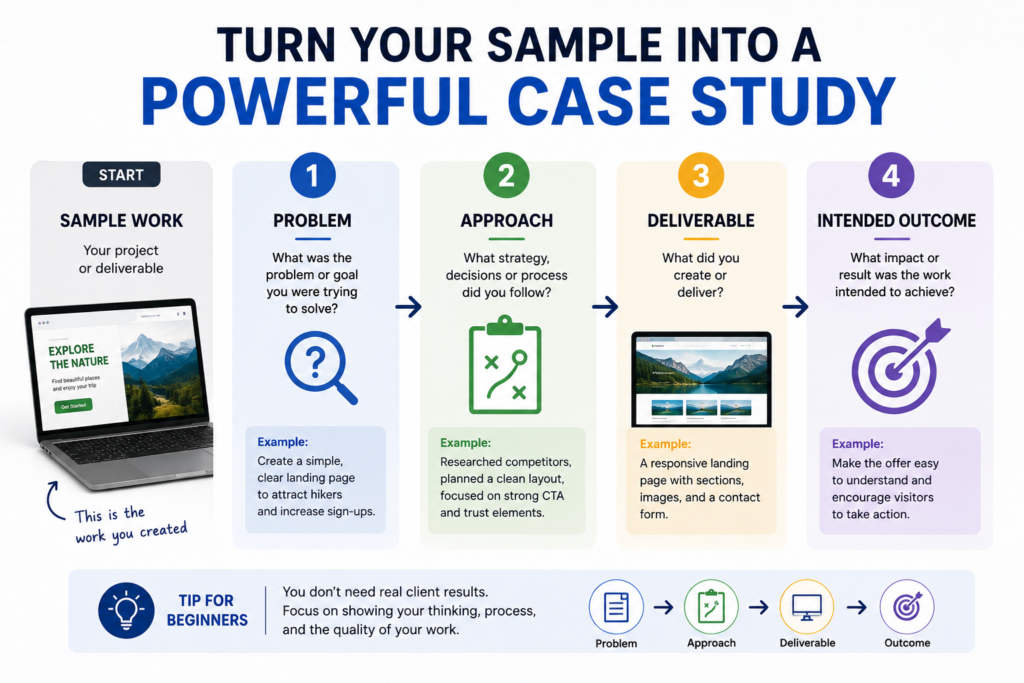
Turn Each Portfolio Sample Into a Mini Case Study
You don’t need a 1,500-word case study for every project.
For a beginner, a compact four-part structure works well:
1. Problem
What was the fictional, personal or real problem you were trying to solve?
2. Approach
What decisions did you make, and why?
3. Deliverable
What did you actually create?
4. Result or intended outcome
If it’s a sample project, don’t invent performance data.
Instead of:
“This landing page increased conversions by 37%.”
say:
“The redesign was created to make the offer easier to understand and give the primary call to action more visual emphasis.”
That is truthful.
Once you complete real client work, you can replace assumptions with genuine results where you have permission and evidence to share them.
A simple beginner case-study example
Project: Email welcome sequence for a fictional fitness app
Problem: New users need a clearer introduction to the app’s main features.
Approach: I planned a three-email sequence that introduces one key benefit at a time rather than explaining every feature in the first email.
Deliverables: Three welcome emails with subject lines and calls to action.
Intended outcome: Help new users understand the product and encourage them to complete their first workout.
That’s enough context to show more than the final copy. It gives the client a glimpse of how you think.
Freelance Portfolio Examples for Beginners
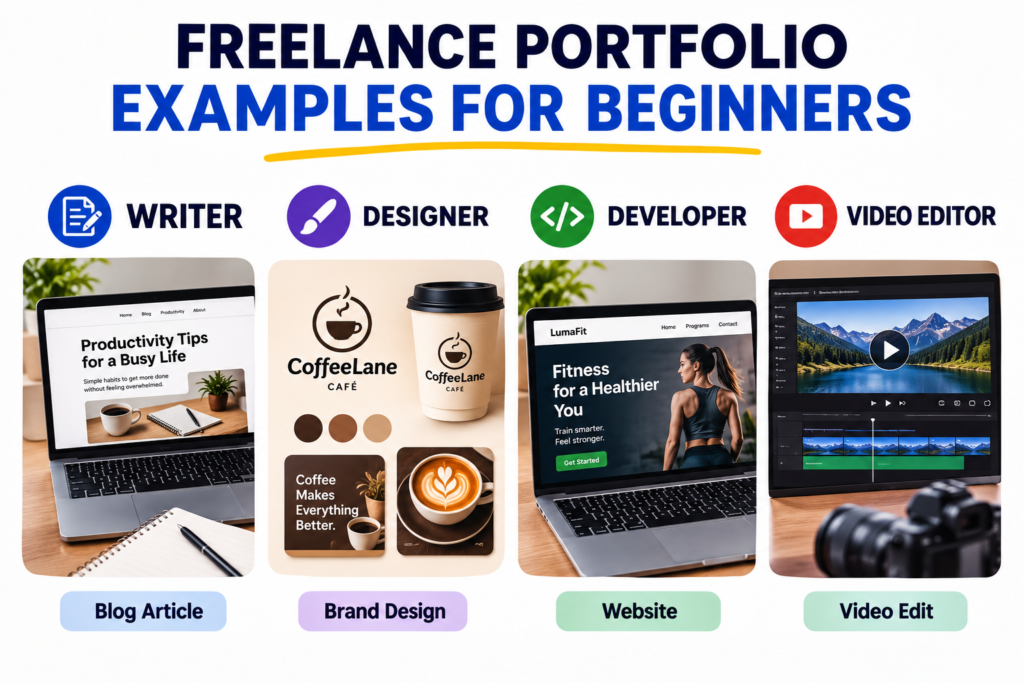
Your samples should depend on what you’re trying to sell.
| Freelance service | Useful beginner portfolio samples |
|---|---|
| Content writer | Blog article, product guide, comparison article |
| Copywriter | Landing page, welcome emails, product page |
| Graphic designer | Brand concept, social media set, marketing asset |
| Web designer/developer | Landing page, small-business website, redesign concept |
| Video editor | Short-form edit, product video, talking-head edit |
| Social media manager | Content calendar, post set, campaign concept |
| Virtual assistant | Workflow dashboard, inbox process, research/organization sample |
| SEO freelancer | Content brief, on-page audit, keyword/content mapping example |
Notice what isn’t in this table:
“Create whatever is easiest.”
Your samples should make sense next to the jobs you’re planning to pursue.
That connection becomes particularly important when you start approaching clients. Our how to get your first freelance client explains the wider client-acquisition process; your portfolio becomes the proof you can attach to those pitches rather than trying to convince someone with claims alone.
Where Should You Build Your Freelance Portfolio?
You don’t need a custom website before you start applying for work.
That’s worth emphasizing because beginners can easily spend a week designing a portfolio website while having nothing meaningful to put inside it.
Start with the simplest format that presents your work professionally.
Freelance marketplace profile
If you’re finding clients through a marketplace, its built-in portfolio may be enough initially.
For example, Upwork currently allows portfolio items to contain project titles, roles, descriptions, skills/deliverables and supporting content such as images, documents, video and external links.
Canva portfolio
For a beginner who wants a simple visual portfolio without building a full website, Canva’s portfolio website builder provides editable portfolio templates and lets users publish a one-page portfolio on the web. Canva also says its one-page templates are mobile responsive.
Contra profile or portfolio
Contra is another option built around independent professionals. A free Contra profile can display work, while its dedicated portfolio website functionality is a separate upgraded offering.
Your own website
A personal website gives you more control over branding, structure and how your work is presented.
But it is an upgrade, not a prerequisite.
If you’re starting with zero samples, build the samples first.
A beautiful empty website isn’t a portfolio.
How Many Projects Should a Beginner Portfolio Have?
There isn’t a magic number.
But for someone starting from zero, 2–4 strong, relevant pieces is a sensible target.
The goal isn’t to make your portfolio look large.
The goal is to answer:
“Can this freelancer do the kind of work I need?”
If three projects answer that question convincingly, adding seven weaker ones can make the portfolio worse rather than better.
This aligns with Upwork’s current recommendation to be selective and showcase your best work instead of everything you’ve created.
As you complete paid projects, replace weaker practice pieces with stronger real-world work.
Your portfolio should evolve with your career.
Common Beginner Portfolio Mistakes to Avoid
A few mistakes can make otherwise good work harder to trust.
Pretending sample work was paid client work
Don’t do this.
Calling something a sample project, personal project or concept project doesn’t make it worthless. It makes you honest.
Showing unrelated work
If you’re pitching SaaS blog writing, a collection containing poetry, a restaurant logo and an Excel sheet doesn’t strengthen the pitch.
Relevance usually beats variety.
Writing long descriptions but showing little work
The portfolio exists to demonstrate what you can do.
Explain enough context to make the work meaningful, then let the work speak.
Waiting until everything looks perfect
Your first portfolio is not your permanent portfolio.
Publish a credible version, use it, learn what clients respond to, and improve it as you gain experience.
Using the same portfolio for every type of opportunity
You don’t necessarily need several websites.
You can simply send the most relevant sample first.
If a client needs email copy, lead with email copy—not the unrelated article you’re personally most proud of.
How to Use Your Portfolio to Get Your First Client
Once your portfolio is ready, don’t just publish it and wait.
Use it as evidence inside your client-acquisition process.
Instead of writing:
“I’m a talented copywriter and I think I’d be perfect for this project.”
you can say:
“I saw that you’re looking for someone to write onboarding emails for a SaaS product. I recently created a three-email onboarding sample around a similar use case. Here’s the project if you’d like to see how I approached it.”
The difference is subtle but important.
The first statement asks the client to trust your claim.
The second gives them something to evaluate.
If you’re still deciding where to look for those opportunities, see our best freelancing platforms for beginners. If you’re ready to start approaching clients, move to how to get your first freelance client with no experience.
And once conversations start turning into actual opportunities, don’t choose your price randomly. Our how much should a freelancer charge explains how to think about beginner freelance rates, expenses and pricing models before quoting a client.
A Simple Portfolio Checklist Before You Start Applying
Before sending your portfolio to anyone, check:
- Is my service obvious within a few seconds?
- Are my strongest and most relevant projects easy to find?
- Have I clearly labeled sample/concept work?
- Does each important project explain the problem and my approach?
- Have I avoided fake testimonials or invented results?
- Can someone actually view the work without requesting access?
- Is the portfolio usable on a phone?
- Is there an obvious way to contact me?
- Would I be comfortable delivering this quality to a paying client?
If the answer is yes, you have enough to start.
You don’t need to wait until your portfolio looks like someone else’s after five years of freelancing.
You need credible proof for the work you’re trying to win now.
FAQ
Can I make a freelance portfolio without clients?
Yes. Create relevant sample projects, personal projects or clearly labeled concept work that demonstrates the service you want to sell. Never present practice work as commissioned client work.
How many projects should I put in a beginner freelance portfolio?
Start with roughly 2–4 strong and relevant projects. Quality and relevance matter more than filling the portfolio with as many pieces as possible.
Can I use fake projects in my portfolio?
You can create projects for fictional businesses or realistic practice briefs, but call them sample, concept or personal projects. Don’t invent a client relationship, testimonial or business result.
Do I need a website for my freelance portfolio?
No. A marketplace portfolio, simple online portfolio or other professional presentation can be enough to start. A personal website can make sense later when you want greater control over your brand and presentation.
What if I have no testimonials?
Don’t fabricate them. Let the quality and relevance of your samples provide the initial proof. Genuine testimonials can be added after you start completing client work.
Final Takeaway
Creating a freelance portfolio with no experience isn’t about making yourself look more experienced than you are.
It’s about making your current ability visible.
Choose one service. Think about the clients you want to work with. Create a few realistic projects that resemble the work they actually buy. Explain your thinking clearly. Label sample work honestly. Then start putting that proof in front of potential clients.
Your first portfolio doesn’t need to prove that you’ve already built a successful freelance career. It only needs to give the next client a credible reason to consider giving you your first opportunity.