You do not need thousands of followers to become a UGC creator.
For standard UGC work, a brand pays you to create a photo or video that the brand can publish through its own website, social accounts or advertising campaigns. The brand is buying the content—not necessarily access to your audience.
That does not mean followers never matter. They may matter when a brief asks you to post on your own account, provide account access for partnership advertising or act as an influencer. But for a deliverable-only UGC project, your portfolio, filming ability, reliability and understanding of the brief can matter far more than your follower count.
If you are starting with no audience and no previous clients, your path is:
- Choose a few product categories.
- Study the content brands already use.
- Create honest sample videos with products you own.
- Build a focused UGC portfolio.
- Calculate a sustainable creation fee.
- Price usage rights and extra work separately.
- Approach suitable brands or apply through marketplaces.
- Agree on the scope, rights and payment before filming.
This guide walks through each step without pretending your first brand deal is guaranteed.
Table of Contents
Can You Become a UGC Creator With No Followers?
Yes. You can become a UGC creator with no followers when the brand wants content to publish itself.
A traditional influencer collaboration usually combines content with access to the creator’s audience. A UGC arrangement can involve only the content asset.
That distinction is important because a brand evaluating a deliverable-only UGC creator is more likely to examine:
- video and audio quality;
- whether the creator looks comfortable on camera;
- ability to demonstrate a product clearly;
- strength of the opening hook;
- editing and pacing;
- relevance to the brand’s customer;
- ability to follow a brief;
- communication and turnaround time.
Later’s UGC creator guide similarly explains that creators are hired for their content skills rather than needing a large existing following.
UGC Creator vs Influencer: What Is the Difference?
| Comparison | UGC Creator | Influencer |
|---|---|---|
| What the brand buys | A content asset the brand can use under agreed terms | Content plus access to the creator’s audience |
| Followers | Not normally required for deliverable-only work | Audience size and engagement often affect selection |
| Where content appears | Brand accounts, website, email or advertisements | Usually the creator’s own account, sometimes with additional brand usage |
| Pricing basis | Creation work, deliverables, licensing and add-ons | Content, audience reach, engagement and usage rights |
| Main proof | Relevant samples and reliable delivery | Audience data, engagement and content quality |
Some projects combine both models. If a brand asks you to create a video and publish it to your account, confirm whether its budget includes both content creation and distribution.
What Equipment Does a Beginner UGC Creator Need?
You do not need a professional studio to create your first samples.
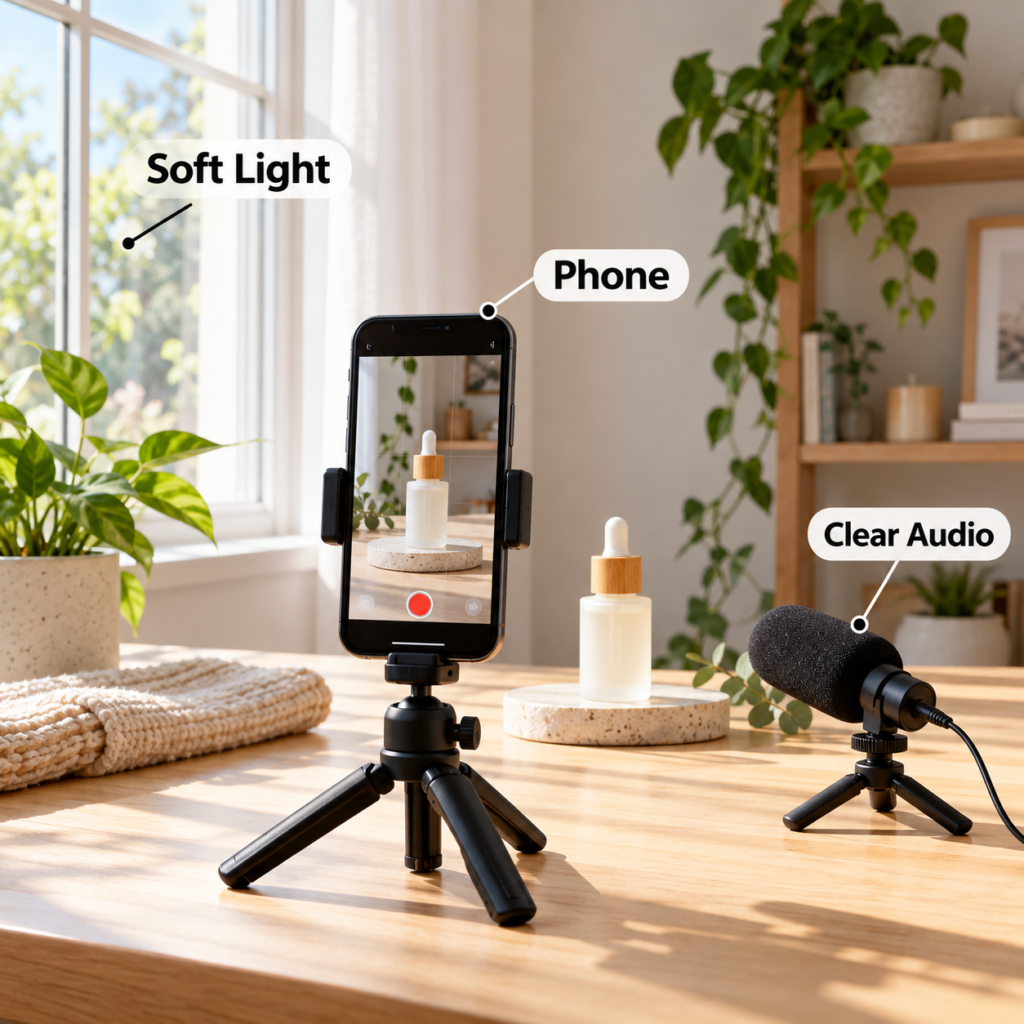
A sensible starter setup includes:
- a phone capable of recording clear vertical video;
- natural window light or another soft light source;
- a quiet recording space;
- a stable tripod or phone support;
- clean products and an uncluttered background;
- basic editing software;
- optional external audio equipment if your phone audio is weak.
Good sound and lighting matter more than buying equipment that you do not yet know how to use.
Before purchasing anything, record a test video with your current phone near a window. Watch it with headphones and check:
- Can you understand every word?
- Is the product clearly visible?
- Does the background distract from the demonstration?
- Does the first sentence create a reason to continue watching?
- Is any on-screen text readable on a phone?
- Can you remove unnecessary pauses?
Upgrade only when you can identify a specific limitation in your current setup.
Step 1: Choose Two or Three Product Categories
A portfolio filled with unrelated videos can make it difficult for a brand to understand where you fit.
Choose two or three categories that meet three conditions:
- You understand the customer.
- You already own products you can demonstrate.
- You would be comfortable creating several videos in that category.
Possible categories include:
- home and organization;
- food and kitchen products;
- software and apps;
- beauty and personal care;
- fitness;
- parenting;
- pet products;
- fashion;
- travel;
- consumer technology.
Do not select a category only because you have heard it pays well. The category should give you enough real familiarity to create believable content without making claims you cannot support.
Step 2: Study the Content Brands Are Already Running
Before filming samples, study what potential clients are currently publishing.
Use the Meta Ad Library to look for brands already running creator-style advertisements. The TikTok Creative Center can also help you study advertising patterns, hooks and product demonstrations.
TikTok describes Creative Center as a public resource containing advertising examples, trends and creative guidance.
Do not copy another creator’s script or visual identity. Instead, examine the structure:
- What problem appears in the opening?
- How quickly is the product shown?
- Is the video a demonstration, testimonial, tutorial or comparison?
- What objections does it answer?
- How long are individual shots?
- Does the video use voiceover, talking-head footage or both?
- What action does the closing request?
Keep a document with brands, products and potential video angles. This becomes both a sample-planning file and an outreach list.
Step 3: Create UGC Samples Without Previous Clients
You can make a UGC portfolio without clients by creating clearly labelled sample or concept videos with products you already own.
Do not imply that a brand hired you when it did not.
A transparent label can say:
Sample UGC concept — independently created and not commissioned by the brand.
Start with three to five strong samples instead of producing 15 weak videos.
Sample 1: Problem-and-Solution Video
Open with a specific everyday problem, show the product being used and explain how it helps.
Avoid exaggerated claims. Demonstrate what a viewer can actually see.
Sample 2: Product Demonstration
Show the product’s important features in a logical order.
A demonstration can work even if you do not appear on camera. Use clear close-ups, hands, voiceover and readable text.
Sample 3: Testimonial-Style Video
Explain what you liked, what type of customer might find the product useful and any relevant limitation.
Only make statements that reflect your genuine experience. A scripted sample should not contain a fake customer result.
Sample 4: Unboxing or First Impression
Show the packaging, included items and initial setup.
An unboxing is useful for demonstrating framing and pacing, but it should not be your entire portfolio.
Sample 5: Objection-Answering Video
Choose one realistic question:
- Is it difficult to set up?
- Will it fit in a small space?
- Is it easy to clean?
- Is it suitable for beginners?
- What is included?
Answer the question visually whenever possible.
If you need more help presenting unpaid work honestly, Tool Sphera’s guide on how to create a freelance portfolio with no experience explains how to use sample and concept projects without inventing clients or results.
Step 4: Build a Focused UGC Creator Portfolio
A UGC creator portfolio should help a brand answer three questions quickly:
- Can this person create the type of content we need?
- Do they fit the customer or creative angle?
- How can we contact them?
Your portfolio does not need to be an elaborate agency website.
Include:
A Clear Introduction
State your name, location, languages and the categories you cover.
Example:
I create short-form product demonstrations, problem-and-solution videos and testimonial-style UGC for home, productivity and consumer-technology brands.
Do not make “I have no followers” the headline. Lead with what you can create.
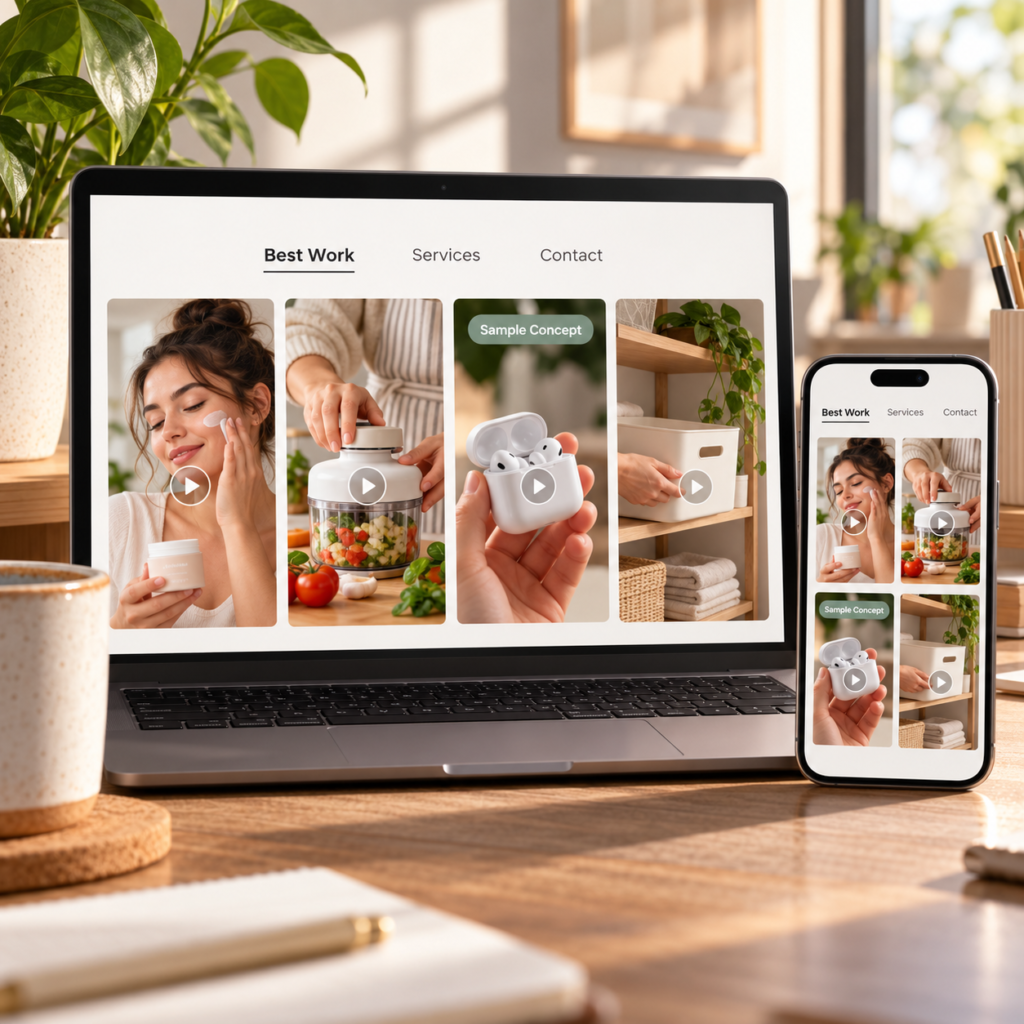
Your Best Work First
Do not arrange samples in the order you filmed them. Put the most relevant, polished video first.
Embed the videos or provide direct viewing links that do not require access permission.
Services
List only services you can genuinely deliver, such as:
- vertical product video;
- voiceover demonstration;
- talking-head testimonial;
- unboxing;
- product photography;
- additional opening hooks;
- raw footage;
- organic posting;
- paid-ad licensing.
Context for Every Sample
For each sample, state:
- content type;
- intended customer;
- concept or problem;
- your role;
- whether it was commissioned or independently created.
Contact Details
Provide one reliable email address and, where useful, your location and languages.
Optional Starting Information
You can show a starting creation fee, but do not present one price as though it includes unlimited revisions and permanent advertising rights.
A better line is:
Projects are quoted according to the deliverables, production requirements, revisions and usage rights.
Test the portfolio on a phone before sending it. Videos should load, text should remain readable and the contact information should be obvious.
Step 5: Set Beginner UGC Creator Rates
There is no universal beginner UGC rate.
The work can vary from one simple edited video for organic social use to multiple hooks, raw footage, paid advertising, exclusivity and access to the creator’s social account.
Start with a production calculation:
Production fee = estimated hours × sustainable hourly floor + direct project expenses
Include time spent on:
- reading the brief;
- researching the product;
- planning the concept;
- writing or adapting a script;
- preparing the filming space;
- filming multiple takes;
- editing;
- adding captions;
- communicating with the brand;
- completing included revisions;
- exporting and delivering files.
Suppose a project is likely to take five hours and your sustainable floor is $30 per hour:
5 hours × $30 = $150 production fee
That is a calculation example, not a universal recommendation. Your expenses, market, skill, tax obligations and production complexity may produce a different answer.
For a broader method of calculating a sustainable price, read how much a beginner freelancer should charge.
What Current Marketplace Data Shows
Collabstr’s 2026 report found an average listed UGC package price of $180 and an average UGC payout of $154 on its platform. It also reported that 80% of all collaborations—not only UGC projects—cost less than $300.
Those figures provide context, but they should not become your automatic rate. They come from one marketplace and combine projects with different requirements.
Quote These Items Separately
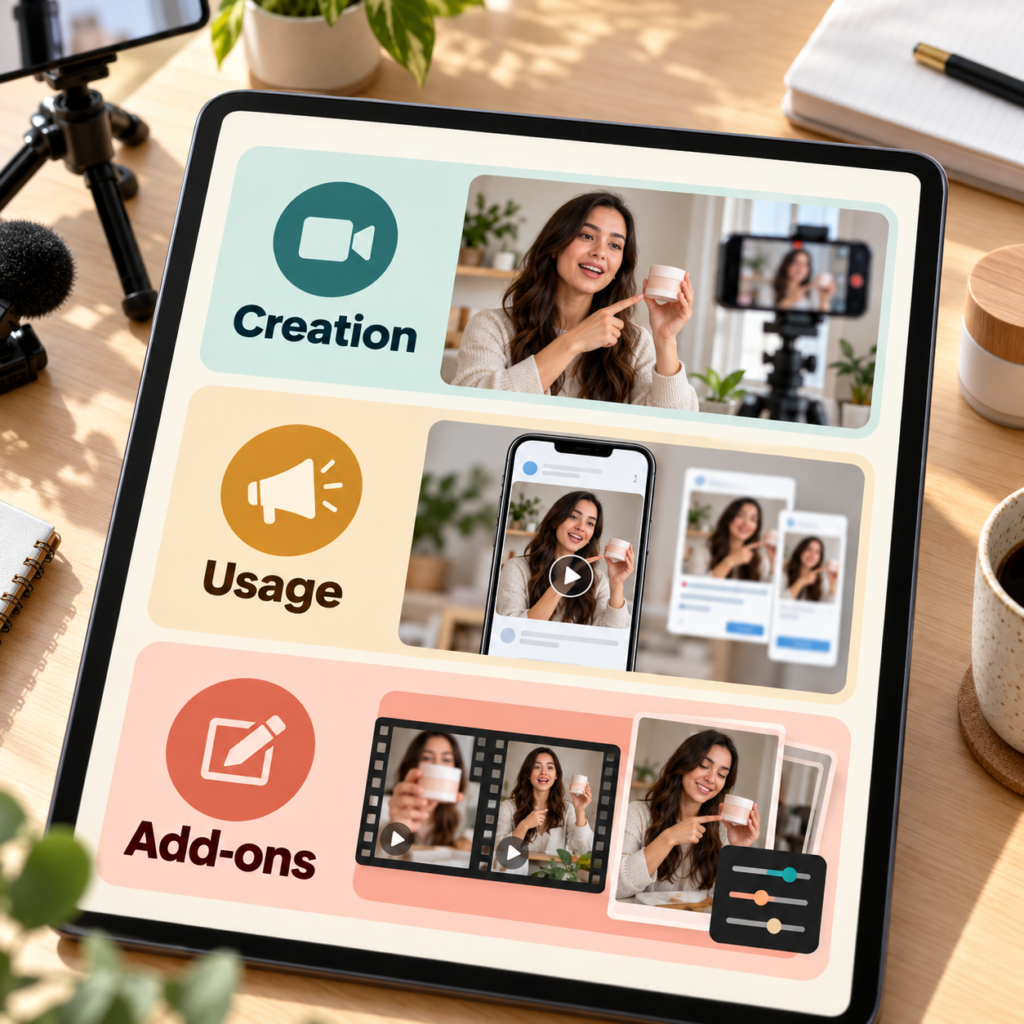
Creation fee
The work required to plan, film, edit and deliver the agreed asset.
Extra hooks or variations
Additional openings, calls to action, scripts or edits create more testing options for the brand and more work for you.
Raw footage
Unedited footage gives the brand greater editing freedom. Do not include it automatically unless you want it included.
Additional revisions
State how many revision rounds are included and what counts as a revision. A new concept or reshoot is not the same as correcting a small editing error.
Fast turnaround
Charge separately when a short deadline disrupts your normal schedule.
Paid-ad usage
A brand using the video in paid advertising receives more commercial value than a brand making one organic post. Define the platforms and length of the licence.
Creator-handle access
Partnership ads, whitelisting and similar arrangements may allow the brand to run advertising through or in association with your account. This is not the same as delivering a video file.
Exclusivity
If you cannot work with competing brands for an agreed period, price the opportunity you are giving up.
Step 6: Understand UGC Usage Rights Before You Quote
A creation fee pays for producing the content. Usage rights determine how the brand can use it.
Before agreeing, clarify:
- organic social or paid advertising;
- specific platforms;
- website, email or product-page use;
- geographic territory;
- licence duration;
- whether the brand may edit the content;
- whether raw footage is included;
- whether your name, likeness or account can be used;
- whether the agreement is exclusive;
- whether ownership is transferred or usage is licensed.
Do not casually agree to “full rights forever everywhere” because it appears in a short message.
Platform rules also differ. Insense explains copyright and usage rights as separate concepts, but another marketplace or direct agreement may contain broader assignment language. Always read the current terms for the particular platform and project.
If the rights language is unclear or has significant financial consequences, obtain appropriate professional legal advice before signing.
Step 7: Find Brands That Already Use Creator Content
Do not begin by sending the same message to hundreds of random companies.
Build a smaller, relevant list.
Look for brands that:
- already use creator-style advertising;
- sell products you can demonstrate naturally;
- have active social channels;
- have recently launched a product;
- use several creative angles;
- have content that you could improve with a specific idea.
Record:
- brand;
- product;
- contact name if available;
- contact email;
- current content angle;
- your proposed concept;
- date contacted;
- response;
- follow-up date.
Direct Outreach
Direct outreach gives you control over the brands you approach, but it requires research and consistent follow-up.
The wider prospecting process is covered in Tool Sphera’s guide on how to get your first freelance client with no experience.
UGC Marketplaces
Marketplaces can help you find structured briefs, but availability, creator eligibility, fees, competition and usage terms vary.
Examples include:
JoinBrands’ current guidance says creators are not required to post most standard UGC jobs on their own social accounts. However, creators should still check each individual brief.
Do not depend on one marketplace. A platform can change its eligibility requirements, fees, visibility system or available jobs.
Step 8: Send a Personalized UGC Pitch
A useful pitch proves that you looked at the brand before contacting it.
It should contain:
- the exact product;
- one relevant observation;
- one content idea;
- a link to relevant samples;
- the proposed deliverable;
- one easy question.
UGC Pitch Template
Subject: UGC idea for [product name]
Hi [name],
I noticed that [specific observation about the product, current content or customer question].
I create short-form UGC for [category]. One idea for [product] would be a [15–30 second problem-and-solution/product demonstration/testimonial-style video] built around this opening:
“[Specific hook]”
Here are two relevant samples:
[Portfolio or sample link]
For [clearly defined deliverable], my quote starts at [$___] and includes [one revision/organic usage for the agreed period/other included scope]. Paid-ad usage, raw footage, additional hooks or exclusivity can be quoted separately.
Are you currently testing creator-led content for [product or campaign]?
Best,
[Name]
[Email]
[Portfolio]
Do not claim that you have used a product if you have not. You can pitch a concept based on public information, then confirm that filming depends on receiving or purchasing the product.
What to Agree Before Filming Your First UGC Brand Deal
A positive reply is not yet a complete agreement.
Confirm the following in writing:
Deliverables
- number of videos or photos;
- duration;
- orientation and resolution;
- talking-head, voiceover or product-only format;
- number of hooks or variations;
- captions;
- raw footage;
- file format.
Creative Process
- who writes the script;
- whether the brand must approve the concept;
- mandatory product claims;
- prohibited claims;
- brand guidelines;
- music requirements;
- reshoot conditions.
Timeline
- product-delivery date;
- draft deadline;
- feedback deadline;
- final-delivery date;
- what happens if the brand replies late.
Revisions
State the number of included revision rounds and distinguish between:
- correcting your mistake;
- a reasonable edit within the original brief;
- a new concept;
- a reshoot;
- additional deliverables.
Payment
Confirm:
- total fee;
- currency;
- deposit or milestone;
- invoice process;
- payment method;
- payment deadline;
- responsibility for transaction fees;
- late-payment terms where applicable.
Usage Rights
Confirm:
- organic or paid use;
- channels;
- countries;
- duration;
- editing rights;
- creator-handle use;
- exclusivity;
- ownership or licence.
Product Arrangements
Clarify:
- whether the product is gifted or loaned;
- who pays shipping and customs costs;
- whether it must be returned;
- who pays return shipping;
- what happens if delivery is delayed.
A free product is compensation of value, but it is not automatically fair payment for production work and extensive advertising rights.

Deliver the First Project Professionally
Your first deal should create evidence for the next one.
Before delivery:
- compare the final video with the approved brief;
- check captions and product spelling;
- confirm that licensed music or other assets are permitted;
- watch once with sound and once without sound;
- check the opening frame;
- export at the requested resolution;
- keep an organized copy of the final files and agreement;
- deliver through the agreed method;
- include a short file list.
After approval and payment, ask whether you may:
- show the work in your portfolio;
- identify the brand as a client;
- use the brand’s feedback as a testimonial;
- discuss any verified results the brand later provides.
Do not publish the work yourself unless the agreement allows it.
Disclose Paid or Gifted Relationships Clearly
If you publish content connected to a paid deal, gifted product, discount or another material relationship, disclose it clearly.
The FTC’s disclosure guidance says disclosures should be hard to miss and placed with the endorsement. For video endorsements, the disclosure should be in the video rather than hidden only in the description.
Clear wording may include:
- “Ad”
- “Sponsored”
- “Thanks to [brand] for the free product”
Do not rely on vague terms such as “collab,” and do not make claims about an experience you did not have.
Even a creator outside the United States may need to consider FTC requirements when it is reasonably foreseeable that the content will affect US consumers.
How to Avoid UGC Creator Scams
UGC and brand-ambassador scams often use excitement and urgency to prevent careful checking.
The FTC has warned about scammers impersonating recognized companies and offering free products or large payments before attempting to obtain money, banking information or personal details.
Treat these as warning signs:
- the sender’s domain does not match the brand;
- the sender asks you to pay an upfront “activation” or processing fee;
- a supposed brand sends a check and asks you to forward part of the money;
- the payment exceeds the agreed amount;
- you are asked to buy equipment from a specific unknown vendor;
- the sender wants sensitive financial or identity information before providing a legitimate agreement;
- the offer guarantees unusually high pay for almost no work;
- the person refuses to use an official company email;
- there is no written brief, payment amount or usage-rights language;
- pressure is used to make you act immediately.
If an offer appears genuine, independently visit the company’s official website and contact the company through a verified channel. Do not use contact details supplied only by the suspicious sender.
Read the FTC’s warning about bogus brand ambassador managers before responding to an unexpected offer.
A 14-Day UGC Creator Starter Plan
This plan does not guarantee a brand deal. It gives you a manageable way to prepare and begin outreach.
Days 1–2: Choose Your Direction
- Select two or three product categories.
- List products you already own.
- Study 10–15 relevant brand videos and advertisements.
- Record useful hooks, formats and objections without copying scripts.
Days 3–6: Create Samples
- Write three to five simple briefs.
- Film different content formats.
- Edit for clear sound, readable text and deliberate pacing.
- Label each sample honestly.
Days 7–8: Build the Portfolio
- Add your introduction, services, best samples and contact information.
- Put the strongest sample first.
- Test every video and link on a phone.
Day 9: Prepare Rates and Terms
- Calculate your sustainable production fee.
- Decide how many revisions are included.
- Create separate quote lines for raw footage, extra hooks, paid usage and exclusivity.
- Prepare a simple agreement and invoice process.
Days 10–11: Build a Prospect List
- Find suitable brands.
- Record one observation and one idea for each.
- Remove companies that do not fit your portfolio.
Days 12–14: Start Outreach
- Send a manageable number of personalized pitches.
- Track every message.
- Follow application instructions carefully.
- Improve the pitch if nobody responds.
- Improve the portfolio or offer if brands view your work but do not continue the conversation.
Common UGC Creator Mistakes
Waiting to Grow an Audience First
If you want deliverable-only UGC work, create proof of your production ability instead of waiting for a follower milestone.
Copying Viral Scripts
Study structure and audience problems, but create an original angle.
Hiding That Portfolio Work Is a Sample
Transparent concept work is more trustworthy than a false client claim.
Quoting Before Understanding the Rights
A low creation fee can become a poor deal if it includes permanent advertising use, raw footage and exclusivity.
Including Unlimited Revisions
Define what is included and what requires a new quote.
Accepting Exposure as the Entire Payment
Exposure is uncertain. Evaluate the actual work, product value, rights and opportunity cost.
Giving Away Raw Footage Automatically
Raw footage has additional value and can allow the brand to create many variations.
Buying Too Much Equipment
Improve lighting, sound, framing and scripting before assuming more equipment will improve the work.
Promising Results You Cannot Control
A creator can deliver an agreed asset. Sales and advertising performance also depend on the offer, media buying, landing page, audience, price and campaign strategy.
Frequently Asked Questions
How Many Followers Do You Need to Become a UGC Creator?
For deliverable-only UGC work, you may not need any followers. The brand evaluates your content and uses it through its own channels. Followers may matter when the project requires posting to your account or using your account for advertising.
Can You Become a UGC Creator With No Experience?
Yes, but you still need proof of your ability. Create three to five honest sample videos using products you already own and label them as independent sample or concept work.
How Many Videos Should Be in a Beginner UGC Portfolio?
Three to five strong, relevant videos are enough to start. Show several formats, such as a demonstration, problem-and-solution video, testimonial-style sample and objection-answering video.
How Much Should a Beginner UGC Creator Charge?
Calculate the actual production time, sustainable hourly floor and expenses. Then quote paid usage, raw footage, additional hooks, extra revisions, creator-handle access and exclusivity separately. Marketplace averages are context, not a universal rate.
Can I Use Products I Already Own in My UGC Portfolio?
Yes. Use products you genuinely understand and clearly label the work as an independently created sample if the brand did not commission it.
Do UGC Creators Have to Post on Their Own Social Accounts?
Not always. A standard UGC job may require only delivery of the content file. Some briefs also require organic posting, influencer distribution or creator-handle advertising, so read the scope carefully.
Is a Free Product Enough Payment for UGC?
That depends on the product’s real value, the work required and the rights requested. A gifted product should not automatically buy extensive production work and permanent advertising rights.
How Long Does It Take to Get a First UGC Brand Deal?
There is no reliable deadline. Your samples, category, location, language, targeting, offer, outreach quality and consistency all affect the result. Avoid anyone promising a guaranteed deal within a fixed number of days.
Final Takeaway
Learning how to become a UGC creator with no followers is less about building an audience and more about building credible proof.
Choose categories you understand. Create a small set of honest samples. Make your portfolio easy to evaluate. Calculate your production fee instead of copying a random rate. Separate usage rights and extra work. Approach brands with a specific idea, and do not begin filming until the scope, payment and rights are clear.
Your first portfolio does not need to make you look famous. It needs to show that you can create useful content and handle a real project professionally.