Getting your first freelance client can feel like a frustrating loop.
You need experience to get clients.
But you need clients to get experience.
You look at other freelancers and see years of experience, dozens of reviews and impressive portfolios. Then you look at your own profile and think:
“Why would anyone hire me?”
That question is understandable.
But it also makes many beginners approach freelancing in the wrong order. They spend months learning another course, redesigning their profile, watching videos about freelancing or waiting until their portfolio feels “perfect.”
Meanwhile, they aren’t actually talking to potential clients.
The first freelance client usually doesn’t come from having the perfect profile. It comes from having something useful to offer, enough proof to reduce the client’s risk, and the willingness to actively look for the right opportunity.
You don’t need ten years of experience.
You don’t need 100 testimonials.
And you don’t need to pretend you’ve worked with clients when you haven’t.
You need a simple system.
In this guide, you’ll learn how to get your first freelance client with no experience by going from:
Skill → Proof → Offer → Profile → Prospects → Outreach → Conversation → Project → Testimonial → Next Client
Let’s start with the part most beginners get wrong.
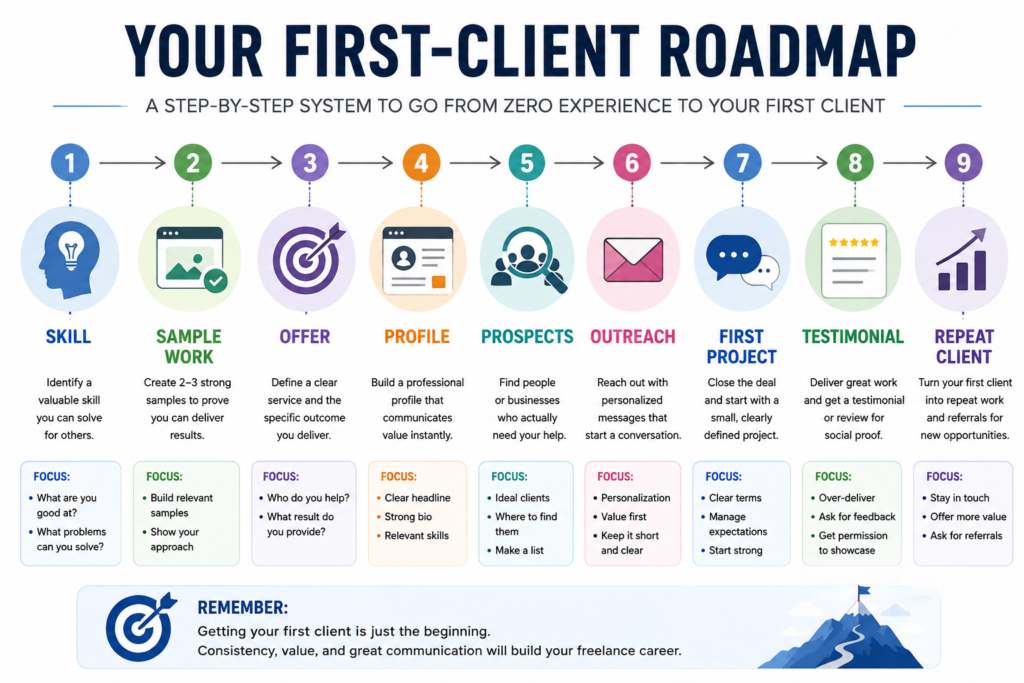
Table of Contents
You Don’t Need Experience, But You Do Need Proof
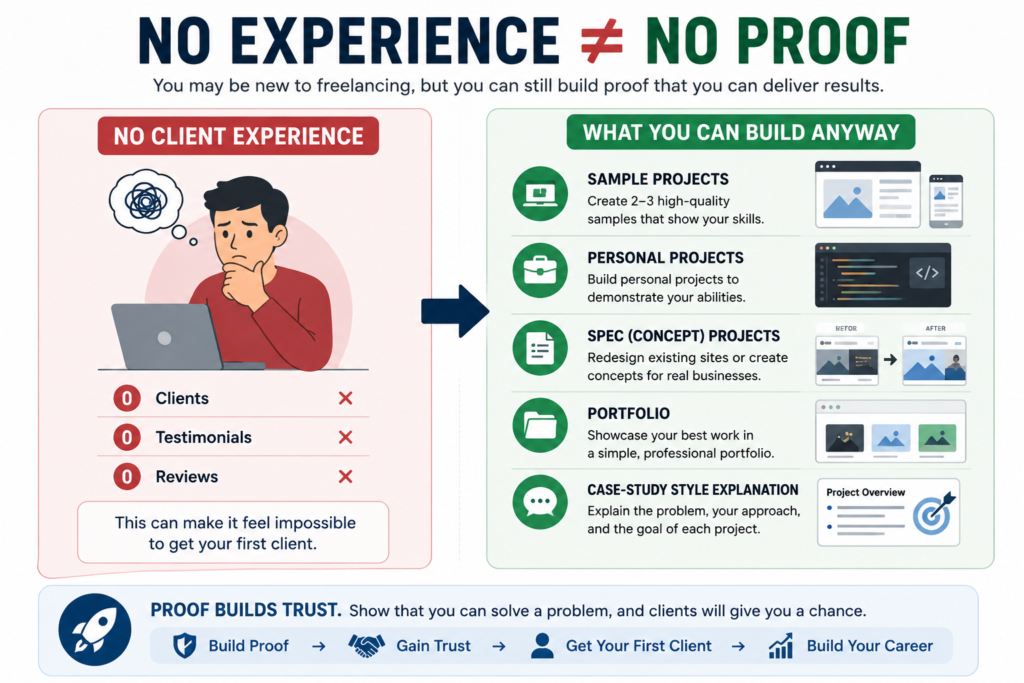
There is an important difference between professional experience and evidence that you can do the work.
A client may not care whether you’ve already completed 50 paid projects if you’re applying for a small task they can easily evaluate.
What they care about is whether they believe you can solve their problem.
If you’re a beginner web designer, for example, you may not have a client website to show.
That doesn’t mean you have nothing to show.
You could build a sample website for a fictional restaurant.
If you’re a writer, you could create three well-written sample articles.
If you’re a video editor, you could edit a short sample video.
If you’re a social media manager, you could create a sample content calendar and several example posts for a fictional business.
These are samples, not fake client work.
That distinction matters.
Never tell a potential client that a sample project was paid client work when it wasn’t.
Instead, explain what it is:
“This is a sample landing page I created to demonstrate how I would approach a SaaS website.”
That is honest—and still useful.
Your first objective isn’t to prove that you’ve already been successful.
It’s to give the client enough evidence to believe that you can successfully complete the specific job they’re considering.
If you don’t have previous client work to show yet, that doesn’t mean you have to approach clients empty-handed. You can create a freelance portfolio with no experience using relevant sample, personal and concept projects that demonstrate what you can actually deliver.
Step 1: Choose One Service You Can Actually Sell
Before searching for clients, get specific about what you’re offering.
This sounds obvious, but beginners often create profiles that say:
“I am a freelancer and I can do web development, graphic design, SEO, social media, video editing, content writing, data entry and digital marketing.”
That sounds like someone who is looking for work.
It doesn’t sound like someone who solves a particular problem.
Instead, narrow the offer.
For example:
Too broad:
“I do graphic design.”
Better:
“I design social media posts for small businesses.”
Too broad:
“I am a web developer.”
Better:
“I build simple WordPress websites for local businesses.”
Too broad:
“I am a writer.”
Better:
“I write SEO blog posts for small SaaS companies.”
You don’t have to choose a niche for the rest of your career.
You’re simply making it easier for the right person to understand what you do.
A Simple Formula for Your First Offer
Try:
I help [type of client] achieve [specific outcome] through [service].
For example:
“I help local restaurants improve their online presence through simple WordPress websites.”
Or:
“I help small businesses stay active on social media by creating their weekly content.”
The more clearly you can explain your service, the easier it becomes to find people who might need it.
Step 2: Create 2–3 Strong Samples Before Chasing Clients
You don’t need a huge portfolio.
You need relevant proof.
Two or three strong samples are often more useful than fifteen unrelated pieces.
Suppose you want to offer website design.
Don’t create:
- one logo,
- one poster,
- one YouTube thumbnail,
- one app icon,
- and one random website.
Instead, create two or three projects that look like the work you want to sell.
For example:
Sample 1: Restaurant website
Sample 2: Local cleaning company website
Sample 3: Small consulting business website
Now a potential business owner can look at your work and immediately understand what you can do for them.
Make Samples Look Like Real Projects
Don’t just upload the finished image.
Explain the thinking behind it.
For example:
Project: Restaurant landing page
Problem: The fictional restaurant had no clear online menu or booking path.
What I created: A responsive landing page with menu sections, location information and a prominent booking button.
Goal: Make it easier for visitors to understand the restaurant and take the next step.
This starts turning a simple sample into a mini case study.
You don’t need to exaggerate results.
You simply explain what you were trying to solve.
Step 3: Build a Simple Portfolio
Once you have your samples, put them somewhere a potential client can easily view them.
You don’t necessarily need an expensive website.
Depending on your service, you could use:
- a simple personal website,
- Notion,
- Google Drive,
- Behance,
- GitHub,
- a professional LinkedIn profile,
- or a relevant freelance platform.
The platform matters less than the presentation.
Your portfolio should answer three questions quickly:
What do you do?
Who do you help?
What can you actually make or deliver?
Don’t make the visitor hunt for those answers.
What to Put on a Beginner Portfolio
A simple portfolio can contain:
- A short introduction
- Your main service
- Two or three relevant samples
- A short explanation of each project
- The tools or skills you used
- A way to contact you
That’s enough to begin.
You can make it better as you gain real projects.
And that leads to an important point:
Don’t wait until your portfolio looks like an agency website.
Your first portfolio only needs to make you look credible enough to start a conversation.
Step 4: Create a Client-Focused Profile
Your profile isn’t supposed to tell the entire story of your life.
It’s supposed to help a potential client decide whether you’re worth talking to.
Instead of opening with:
“My name is Ali and I am passionate about technology and have always loved computers…”
start with what you can help the client accomplish.
For example:
“I help small businesses build clean, mobile-friendly WordPress websites that make it easier for customers to understand their services and get in touch.”
Then briefly explain:
- what you specialize in,
- what you can deliver,
- what tools you use,
- and where the client can see examples.
Upwork’s current beginner guidance makes a similar point: a freelancer profile acts as a storefront/resume and should clearly communicate skills, portfolio and relevant experience.
Don’t Hide the Fact That You’re New
You don’t have to announce:
“I have absolutely no experience and nobody has ever hired me.”
But don’t invent experience either.
Instead, position yourself around your strengths.
For example:
“I’m a new freelance WordPress developer focused on helping small businesses with clean, responsive websites. I’ve built several practice projects to demonstrate my approach and I’m currently taking on a small number of projects.”
That’s honest without making your lack of experience the headline.
Step 5: Decide Where Your First Clients Will Come From
There isn’t one magical website where all beginners should search.
You have several routes.
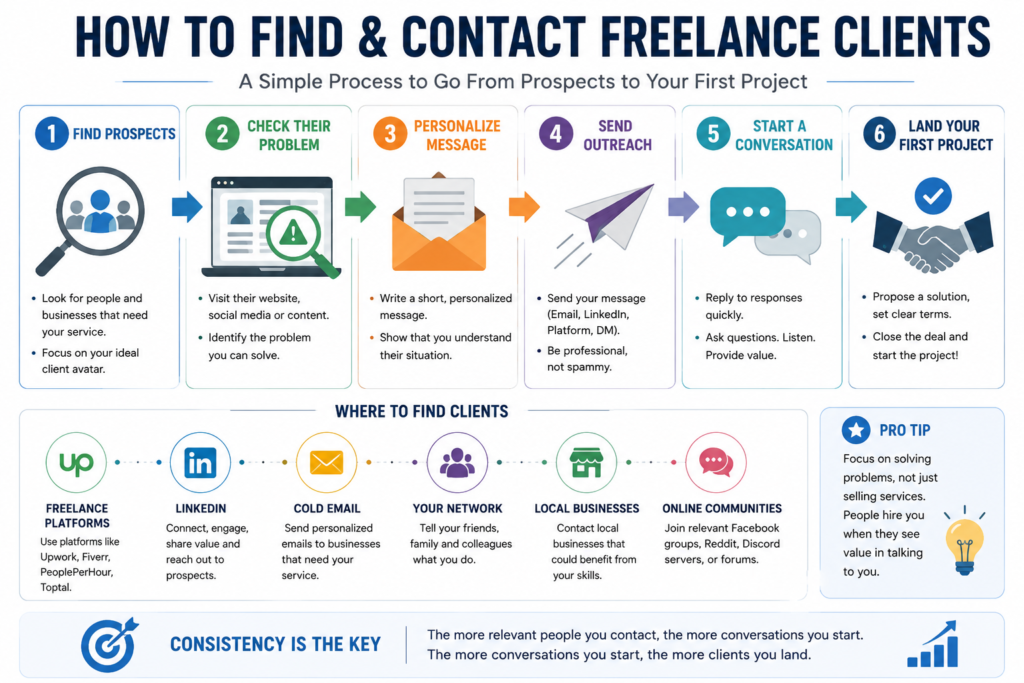
Freelance Platforms
Platforms such as Upwork and Fiverr can give beginners access to people who are already looking for freelance services.
The advantage is obvious:
You don’t always have to convince someone that they need a freelancer.
They’re already searching for one.
The downside is competition.
You’ll be competing against freelancers with established profiles, reviews and previous work.
That’s why your offer and targeting matter.
Don’t apply to every job you see.
Look for projects where your current skills genuinely match what the client needs.
Platforms such as freelance platforms for beginners can give beginners access to people who are already looking for freelance services.
Your Existing Network
This is one of the most overlooked sources of a first client.
Think about:
- friends,
- relatives,
- former classmates,
- former coworkers,
- local business owners,
- community members,
- people you already interact with online.
You don’t need to ask them:
“Do you have freelance work for me?”
Instead, make your service known.
For example:
“I’ve recently started offering WordPress website setup for small businesses. I’m building my freelance portfolio and I’m currently taking on a couple of small projects.”
Someone may know a person who needs exactly that.
You aren’t begging for work.
You’re making yourself easier to refer.
LinkedIn can work particularly well for professional services.
You can search for businesses and people who fit your target market, publish useful work, engage with relevant posts and reach out when there is a genuine reason to do so.
Don’t send hundreds of identical messages.
A message that says:
“Hello sir, I am a professional web developer. Do you need a website?”
is easy to ignore.
A message that demonstrates you’ve actually looked at the business is much stronger.
Direct Outreach
You can also approach potential clients directly through email or other professional channels.
This works best when you’ve identified a real problem.
For example, suppose you find a local business with:
- an outdated website,
- broken mobile layout,
- unclear service information,
- poor images,
- or no obvious contact path.
Instead of saying:
“I offer web design services.”
you could say:
“I noticed your website works well on desktop, but the services section becomes difficult to navigate on mobile. I put together a quick example showing how I’d simplify that section. If you’re considering a redesign, I’d be happy to walk you through it.”
That’s a completely different conversation.
Step 6: Find People Who Actually Need Your Service
This is where freelancing starts becoming less about “finding jobs” and more about finding problems you can solve.
If you’re a beginner graphic designer, don’t simply search:
“graphic design jobs.”
Look for businesses that regularly need graphics.
If you’re a video editor, look for creators or companies publishing videos consistently.
If you’re a copywriter, look for businesses that publish blogs, newsletters, product pages or marketing content.
The question becomes:
Who has the problem my service solves?
Build a Small Prospect List
You don’t need 1,000 leads.
Start with 30–50 relevant prospects.
Create a simple spreadsheet with:
| Prospect | Business | Problem | Contact | Date Contacted | Response | Follow-up |
|---|---|---|---|---|---|---|
| Prospect name | Business name | Problem you noticed | Email / LinkedIn | Date contacted | Reply status | Follow-up date |
This prevents you from repeatedly messaging the same people and helps you learn which outreach actually gets responses.
And once you start doing this consistently, you have something much more valuable than random motivation:
data.
You’ll see which types of businesses respond.
Which offer gets attention.
Which message gets ignored.
And which problems people are actually willing to pay you to solve.
Step 7: Write Outreach That Doesn’t Sound Like Spam
Your outreach doesn’t need to be long.
In fact, beginners often make it worse by writing too much.
The person you’re contacting doesn’t care about your entire career history.
They care about whether you understand their problem.
A simple cold message could look like this:
Subject: Quick idea for [Business Name]
Hi [Name],
I came across [Business Name] while looking at local [industry] businesses and noticed [specific observation].
I’m a freelance [service] and I’ve been working on projects focused on [relevant outcome].
I put together a quick example of how I would improve [specific problem].
If you’re considering improving this area, I’d be happy to send it over.
Best,
[Name]
Notice what isn’t there.
There’s no:
“I am the best freelancer.”
No:
“I guarantee amazing results.”
No:
“Please give me a chance.”
You’re simply opening a relevant conversation.
Step 8: Personalize Every Serious Pitch
Personalization doesn’t mean writing a completely different essay for every prospect.
It means proving that you actually looked at the person’s situation.
Mention:
- their business,
- their product,
- their website,
- a recent post,
- a specific problem,
- or something relevant to their project.
If you’re applying through a platform, mention something specific from the job description.
Upwork’s own current guidance recommends personalized proposals rather than generic templates and emphasizes showing that you understand the client’s challenge.
A useful structure is:
Observation → Problem → Solution → Relevant proof → Next step
For example:
“I noticed you’re redesigning the homepage to improve lead generation. I’d focus first on simplifying the hero section and making the primary CTA more obvious. I recently created a similar landing-page concept, which you can see here. If you’d like, I can explain how I’d approach your page.”
Short.
Specific.
Relevant.
Step 9: Don’t Compete Only on Price
When beginners have no experience, their first instinct is often:
“I’ll just be cheaper.”
That’s understandable.
But becoming the cheapest freelancer in the market is not a great long-term strategy.
A client who chooses you only because you’re the cheapest can easily leave when someone offers an even lower price.
Instead, compete through:
- clear communication,
- a specific offer,
- fast responses,
- relevant samples,
- realistic deadlines,
- attention to detail,
- and making the project easy for the client.
You can still price reasonably while you’re building experience.
But don’t confuse beginner pricing with destroying your own value.
Step 10: Start With a Small, Clearly Defined Project
Your first project doesn’t need to be huge.
In fact, a smaller project may be better.
Suppose you’re a beginner video editor.
Instead of trying to sell a $2,000 monthly editing package, you could offer:
“I can edit one short-form video so you can see how I handle your style.”
If you’re a web developer:
“I can fix the mobile layout on these three pages.”
If you’re a writer:
“I can write one 1,500-word article based on your brief.”
The goal is to reduce the client’s perceived risk.
A small project gives both sides a chance to see whether the relationship works.
If you deliver well, that small project can become:
Project → Testimonial → Repeat work → Referral
Step 11: Protect Yourself Before Starting the Work
Getting your first client is exciting.
It can also make beginners accept almost anything.
Don’t.
Before starting, make sure you and the client agree on:
- what you’re delivering,
- when you’re delivering it,
- how much it costs,
- how and when you’ll be paid,
- how many revisions are included,
- what the client needs to provide,
- and what happens if the scope changes.
Put important agreements in writing.
A contract can help define payment, deliverables, timelines, responsibilities and other terms, and can reduce misunderstandings and scope disputes.
If you’re working through a platform, understand that platform’s payment and protection rules rather than assuming every project is automatically protected.
For example, Upwork’s payment protection has specific requirements for hourly work, including using its time tracker and meeting its eligibility conditions.
Once the payment terms are clear, use a consistent invoicing system so the client knows exactly what is due, when it is due, and how to pay. Our best invoicing software for freelancers comparison can help you choose the right setup.
Don’t Do Large Projects on a Handshake
You don’t need a 20-page legal agreement for a tiny job.
But you do need clear written terms.
The bigger the project, the more important this becomes.
Your excitement about getting your first client should never make you forget that you’re running a business.
Step 12: Deliver Better Than the Client Expects
Your first client isn’t just about the money.
It’s your first opportunity to create proof.
That means communication matters almost as much as the final work.
If something will be delayed, tell the client early.
If you need information, ask clearly.
If you notice a problem with the original scope, explain it rather than silently making assumptions.
And don’t disappear after receiving the payment.
Professionalism creates something beginners desperately need:
trust.
Your first client should ideally leave you with:
- completed work,
- a testimonial,
- permission to show the work in your portfolio,
- experience communicating with a real client,
- and a better understanding of how projects actually work.
Step 13: Ask for a Testimonial at the Right Time
Don’t immediately ask:
“Can you give me a five-star review?”
Wait until the client has seen the finished work and is happy with it.
Then make the request easy.
For example:
“I’m glad you’re happy with the final result. I’m building my freelance portfolio and a short testimonial about your experience would really help. If you’re comfortable, I’d appreciate two or three sentences about the project and what you liked about working together.”
If the client provides a testimonial, ask for permission to use it publicly if you’re going to publish it on your website or portfolio.
Don’t manufacture testimonials.
Don’t ask friends to pretend they’re clients.
And don’t edit a client’s words into something they never said.
Your first genuine testimonial is worth far more than ten fake ones.
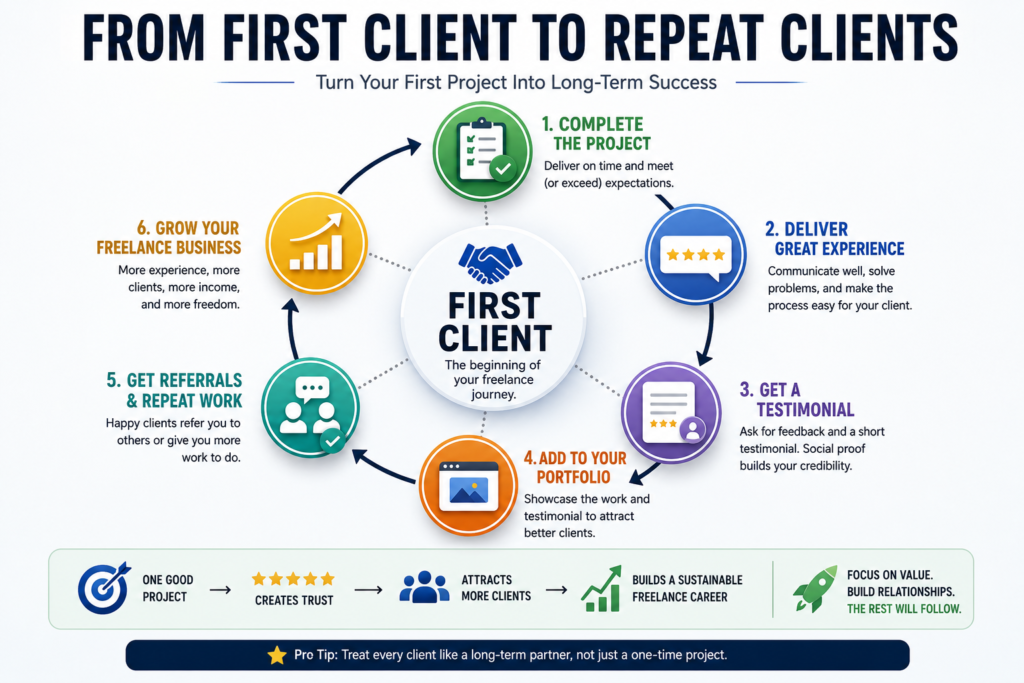
Step 14: Turn the First Client Into the Second Client
This is where many beginners stop too early.
They complete the project.
Get paid.
Celebrate.
Then go back to zero.
Instead, ask yourself:
What happens next?
Maybe the client needs monthly work.
Maybe they need another service.
Maybe they know another business owner who needs the same thing.
You don’t have to aggressively upsell.
Simply stay useful.
For example:
“If you’d like, I can also help maintain the website each month so you don’t have to handle the updates yourself.”
Or:
“If you know another business that needs similar help, I’d be happy to speak with them.”
The objective is to turn one successful transaction into a relationship.
Upwork’s own client-acquisition guidance similarly emphasizes building relationships that can lead to repeat work and referrals rather than treating every project as a one-time transaction.
What If Nobody Responds to Your Outreach?
This is probably the part beginners need to hear most.
You may send ten messages and receive nothing.
Then twenty.
Still nothing.
That doesn’t automatically mean you’re bad at freelancing.
It means you need to diagnose the problem.
Look at four things:
Your Offer
Is it clear what you actually do?
Your Targeting
Are you contacting people who genuinely need the service?
Your Proof
Does your portfolio demonstrate the exact type of work you’re offering?
Your Message
Does your outreach talk about the client’s situation—or mostly about yourself?
Change one variable at a time.
Don’t completely rebuild your freelance business after five unanswered messages.
Give your process enough attempts to produce useful information.
A Simple First-Client Strategy You Can Follow
If everything above feels like too much, simplify it.
Your first goal can be:
Week 1 — Prepare
Day 1: Choose one service.
Day 2: Define your target client.
Day 3: Create your first sample.
Day 4: Create your second sample.
Day 5: Build a simple portfolio.
Day 6: Create your freelance profile.
Day 7: Write your outreach message and prepare a prospect list.
Week 2 — Start Looking
Find relevant prospects.
Apply for suitable freelance jobs.
Contact people in your network.
Publish useful examples of your work.
Don’t wait for everything to be perfect.
Week 3 — Improve
Track:
- messages sent,
- replies,
- conversations,
- calls,
- proposals,
- and projects won.
If nobody replies, improve the targeting or message.
If people reply but don’t book calls, improve the offer.
If calls happen but nobody hires you, look at your positioning, pricing, proof or communication.
Week 4 — Deliver
Once you land the first project, focus on doing excellent work.
Then ask for the testimonial.
Add the project to your portfolio.
Ask whether there’s another way you can help.
And start prospecting again.
Common Mistakes That Keep Beginners From Getting Their First Client
Waiting Until You Feel Ready
You probably won’t.
Confidence usually comes after doing the work, not before it.
Offering Too Many Services
If your profile says you can do everything, clients may not know what to hire you for.
Creating a Huge Portfolio
Three relevant samples can be more useful than twenty random ones.
Sending Generic Messages
Copy-pasting the same pitch to everyone makes your outreach look like spam.
Applying for Jobs You Can’t Actually Do
Your first client isn’t worth damaging your reputation.
Apply where your current ability genuinely matches the work.
Competing Only on Price
Cheap isn’t the same as valuable.
Doing Work Without Clear Terms
This is how scope creep, unpaid work and payment disputes begin.
Giving Up After a Few Rejections
Rejection is part of client acquisition.
The goal isn’t to make everyone say yes.
It’s to find the people who need what you offer.
How Many Clients Should You Contact Every Day?
There is no magic number that guarantees your first client.
You will see advice telling beginners to send 50 or 100 messages every day.
I wouldn’t blindly follow that.
Five highly relevant messages can be more useful than fifty generic ones.
Focus on quality and consistency.
For example, you could start with:
5 targeted applications or outreach messages per day.
If you can maintain that quality while increasing the number, do so.
The important thing is that you are building a repeatable habit rather than spending three days sending hundreds of rushed messages and then disappearing for two weeks.
Should You Use AI to Get Freelance Clients?
AI can help with parts of the process.
For example, you can use it to:
- brainstorm potential client problems,
- research a prospect,
- organize your lead list,
- improve the clarity of a draft message,
- practice answering client questions,
- or prepare questions for a discovery call.
But don’t let AI turn your outreach into generic spam.
A client should feel like you actually looked at their business.
There is also a growing conversation around AI disclosure in freelance work. Recent research found an expectation gap between freelancers and clients around AI use, with clients showing a preference for clearer disclosure when AI meaningfully contributes to the work.
So use AI as an assistant—not as a substitute for judgment, communication and the actual service you’re being hired to provide.
Your First Client Doesn’t Need to Be Your Dream Client
This is another mindset trap.
Your first client doesn’t have to be:
- a famous company,
- an international brand,
- a $5,000 project,
- or someone who will become your biggest client.
Your first client needs to be real.
A small project that gives you genuine experience can be incredibly valuable.
You learn how to:
- communicate with a buyer,
- understand a brief,
- manage deadlines,
- handle revisions,
- deliver files,
- request payment,
- and deal with unexpected problems.
Those lessons are difficult to learn from tutorials.
They’re learned by doing.
The Real Goal Is Not One Client
Getting your first freelance client feels like the finish line.
It isn’t.
It’s the point where the cycle starts:
First client
↓
Real project
↓
Better portfolio
↓
Testimonial
↓
More credibility
↓
Better prospects
↓
Second client
↓
Repeat work and referrals
That is why you shouldn’t become obsessed with making a huge amount of money from your first project.
Your first project is building an asset that can make the next project easier.
And then the next one.
Frequently Asked Questions
Can I get a freelance client with no experience?
Yes. You can start without professional freelance experience, but you still need evidence that you can perform the service. Sample projects, personal projects, relevant skills and a clear offer can help reduce the client’s perceived risk.
How do I get my first freelance client with no portfolio?
Create sample work that demonstrates the service you want to sell. Be transparent that the work is a sample or personal project. Two or three relevant samples are enough to begin outreach.
Is Upwork good for getting your first freelance client?
It can be. Upwork gives beginners access to clients actively posting freelance projects, but competition can be significant. A complete profile, relevant portfolio pieces and personalized proposals can improve your chances. Upwork itself recommends completing your profile and tailoring proposals to the client’s needs.
Is Fiverr good for beginners?
Fiverr can be useful if your service fits a clearly defined gig. Beginners should focus on a specific service, clear listing, relevant examples and professional presentation rather than creating dozens of unrelated gigs.
How do I find freelance clients outside Upwork and Fiverr?
You can use your existing network, LinkedIn, direct outreach, professional communities, local businesses and referrals. The key is to find people who have a problem your service can solve rather than messaging random businesses.
How long does it take to get your first freelance client?
There is no reliable deadline. Some beginners find a client quickly, while others need weeks or months. Your skill, offer, market, portfolio, outreach quality and consistency all affect the process.
Avoid anyone promising that you are guaranteed to get a client in seven days.
Should I work for free to get experience?
You don’t need to work for free simply because you’re new.
Creating your own sample projects is usually a better way to build proof without establishing the expectation that your professional work has no value.
If you decide to do a discounted or free project strategically, define the scope and purpose clearly.
Should my first freelance project be cheap?
It can be smaller or more affordable than your later projects while you’re building experience, but don’t choose a price so low that you cannot deliver the work properly.
Your objective is to create a successful project—not simply to win a job.
What should I do after getting my first client?
Deliver the project professionally, request a testimonial, ask for permission to show the work in your portfolio, and look for opportunities to turn the relationship into repeat work or referrals.
Final Thoughts
Getting your first freelance client with no experience is difficult.
But it isn’t a mystery.
You don’t need to wait until someone magically discovers you.
You need to create something you can sell, build enough proof to demonstrate your ability, find people who actually need it, and start conversations.
The process is simple even if it isn’t always easy:
Choose one service.
Create proof.
Build a simple profile.
Find the right prospects.
Reach out personally.
Start with a manageable project.
Deliver professionally.
Get your first testimonial.
Use that experience to win the next client.
Your first client may not change your life financially.
That’s okay.
What matters is that you stop being someone who is trying to become a freelancer and become someone who has actually completed a paid project for a real client.
From there, you finally have something you didn’t have before:
proof.
And proof makes the second client easier to pursue than the first.