If you’re new to freelancing, one of the hardest questions to answer is surprisingly simple:
“How much should I charge?”
Charge too little and you can end up working for hours without making enough to cover your costs. Charge too much before you have enough proof to support your price, and you may struggle to win those first clients.
The problem is that there isn’t one magic beginner freelance rate.
A writer, virtual assistant, graphic designer, developer and data analyst can all have completely different pricing. Your experience, niche, client market, project complexity, expenses and the amount of time you can actually bill all matter.
A better approach is to calculate three numbers:
- Your minimum rate — the lowest rate that makes the work sustainable.
- Your market rate — what comparable freelancers are charging for similar work.
- Your target rate — the price you want to reach as your skills, proof and demand improve.
Your first freelance rate should sit somewhere you can defend between those numbers. It should not simply be the lowest price you think a client might accept.
Table of Contents
How much should a beginner freelancer charge?
For many common freelance services, a beginner may find a starting hourly rate somewhere in the lower-to-middle portion of the current market range for that specific service.
As a broad practical benchmark, ToolSphera would treat roughly $15–$30/hour as a reasonable starting zone for many general beginner services, while recognizing that some services sit below this range and specialized technical work can start considerably higher.
This is not an industry-wide statistical average.
It is a practical starting benchmark based on current published marketplace ranges and the reality that a beginner normally has less proof than an established freelancer.
For example, current Upwork published ranges include:
| Service | Current marketplace reference | Practical beginner positioning |
|---|---|---|
| Virtual assistance | Around $10–$20/hr | Often $12–$18/hr |
| Graphic design | Around $15–$35/hr | Often $15–$25/hr |
| Web design | Around $15–$30/hr | Often $18–$25/hr |
| Content/writing work | Often around $15–$40/hr depending on specialty | Often $15–$30/hr |
| Digital marketing | Around $35–$50/hr in Upwork’s broader reference | Often lower end while building proof |
| Data analysis | Around $55–$65/hr in Upwork’s broader reference | Can start higher when technical proof is strong |
These are not fixed beginner rates. They are starting points for comparison. Your actual number should come from the calculation and positioning process below.
The mistake is looking at a table like this and deciding, “I’m new, so I’ll always take the lowest number.”
Being new does not automatically mean your work has little value.
It means you have less evidence to justify a premium.
That’s a different thing.
Why there is no single “correct” beginner freelance rate
Freelance pricing depends on several variables that can change the answer dramatically.
Your service
A simple administrative task isn’t priced the same way as custom software development.
A general blog writer isn’t competing in exactly the same market as a technical writer.
A logo designer isn’t selling the same outcome as a UX designer.
Start with the service, not the word “freelancer.”
Your actual skill level
“Beginner freelancer” doesn’t necessarily mean “beginner at the skill.”
You could have five years of professional experience in marketing and only recently start selling that skill independently.
In that situation, you may be new to freelancing but not new to the service.
Your pricing should reflect the distinction.
Your proof
Clients don’t only buy skills.
They buy confidence that you can deliver.
A portfolio, testimonials, previous results, relevant employment history, certifications or strong sample work can all make your rate easier to defend.
Your rate isn’t supported by years of experience alone. Relevant proof also matters. Even without paid client history, a focused freelance portfolio with sample projects can make it easier for potential clients to understand the quality and type of work you’re offering.
This is one reason your rate can change significantly after your first few successful projects.
Your client market
The market where your clients buy services matters.
A freelancer serving international businesses may encounter very different budgets from someone working exclusively with small local businesses.
That doesn’t mean you should pretend to be located somewhere you’re not.
It means you should research the market you are actually selling into.
Project complexity
Two clients may ask for “a website,” but one might need a simple five-page site while the other needs integrations, custom functionality, SEO, analytics and ongoing maintenance.
Same label.
Completely different project.
Your business costs
Freelancers pay for things employees may not have to pay for directly:
- software
- equipment
- internet
- workspace
- insurance
- accounting
- marketing
- taxes
- payment fees
- time spent finding clients
- time spent communicating with prospects
Your price needs to account for the business behind the service.
Calculate your minimum freelance rate before looking at competitors
This is the most important step in the entire article.
Before asking:
“What do other freelancers charge?”
ask:
“What is the lowest rate that allows me to run this freelance business sustainably?”
Call this your minimum sustainable rate.
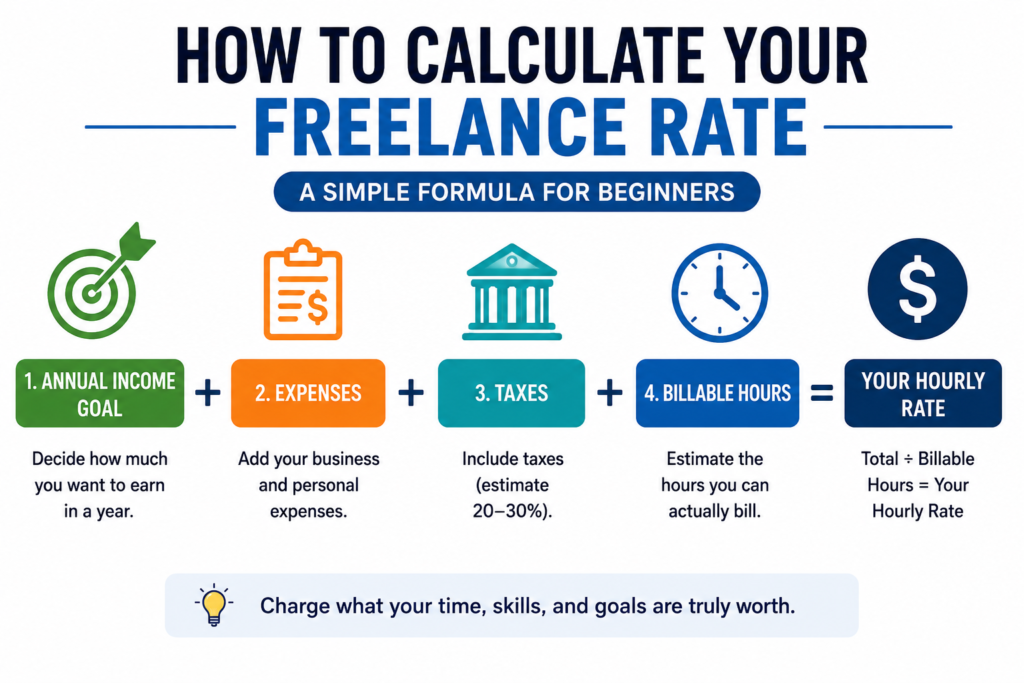
A simple version of the calculation is:
Minimum hourly rate = total annual income requirement ÷ annual billable hours
Your total annual income requirement should include the money you need for yourself plus the costs and reserves required to operate as a freelancer.
That can include:
- desired personal income
- business expenses
- taxes
- insurance or benefits
- software
- equipment replacement
- savings
- other business reserves
And your annual billable hours should not simply be 40 hours × 52 weeks.
You will spend time:
- writing proposals
- talking to prospects
- finding clients
- sending invoices
- answering emails
- marketing yourself
- learning
- managing projects
- handling revisions
- doing administrative work
Upwork’s own rate calculator uses this principle and currently estimates that around 60% of working time may be billable, with the remainder going toward activities such as client sourcing and administration.
A simple example
Imagine a freelancer wants:
- $36,000 for personal income
- $6,000 for annual business expenses
- $9,000 reserved for taxes, benefits and other obligations
That means the freelancer needs to generate:
$51,000 per year
Now suppose they realistically expect to bill clients for 1,200 hours during the year.
$51,000 ÷ 1,200 = $42.50/hour
That $42.50 is not necessarily the rate they should put on every profile.
It is the floor the business needs to work toward.
If the freelancer is currently unable to command $42.50 because they lack proof or are entering a crowded market, the answer isn’t automatically to pretend the business can survive on $15.
They can change the equation.
They might:
- reduce expenses
- improve their service
- specialize
- target better clients
- increase their billable percentage
- package the service differently
- build proof
- move toward higher-value work
This is why pricing is a business decision, not simply a confidence exercise.
Your minimum rate is a floor, not your final price
This distinction is extremely important.
Suppose your minimum sustainable rate is $30/hour.
That doesn’t mean:
“I should charge exactly $30.”
It means:
“I need to understand why accepting less than $30 creates a problem.”
Your actual market rate could be:
- $25/hour
- $35/hour
- $50/hour
- $75/hour
depending on your service and positioning.
The minimum calculation protects you from pricing below sustainability.
Market research tells you whether clients are actually paying enough for your service.
Your proof and positioning determine how close you can get to the upper end.
Research freelance rates for your specific service
Once you know your floor, research the market.
Don’t search for:
“average freelancer rate”
and use the first number you see.
That number is almost meaningless without knowing what service it represents.
Instead search for things such as:
- freelance SEO writer rates
- freelance graphic designer hourly rates
- freelance web designer rates
- freelance virtual assistant rates
- freelance video editor rates
- freelance social media manager rates
- freelance data analyst rates
Then compare people who are actually similar to you.
Look at marketplaces where clients are buying
Upwork is useful because freelancers publicly display hourly rates and the platform publishes rate ranges across many categories.
Its current published data shows substantial variation between services. For example, its ranges include $10–$20/hour for virtual assistants, $15–$35 for graphic designers, $15–$30 for web designers and substantially higher ranges for specialized roles.
Fiverr is useful for a different reason.
Instead of primarily comparing hourly profiles, you can examine how freelancers package services into different offers.
Fiverr itself recommends checking average marketplace pricing, considering how long the service takes, and accounting for the fact that freelancers receive 80% of the purchase amount.
Contra can also be useful when researching project-based pricing because its marketplace supports fixed-price, ongoing and other project structures.
Don’t copy the cheapest freelancer you find
This is one of the fastest ways for a beginner to create a bad pricing strategy.
You might find someone charging $5 for a service.
That doesn’t tell you:
- how experienced they are
- what country they operate from
- whether the scope is comparable
- whether their price is promotional
- whether they have repeat clients
- whether they are profitable
- whether they are even offering the same service
You’re not trying to become the cheapest freelancer on the internet.
You’re trying to become a credible option for a specific client.
How beginner freelance rates should change based on proof
Your rate should not be permanently tied to the word “beginner.”
Think of your career in stages.
Stage 1 — Little or no proof
At this stage, your biggest weakness isn’t necessarily skill.
It’s uncertainty.
The client doesn’t know what it’s like to work with you.
A defensible rate in the lower portion of your market can help you enter without turning your service into a bargain-bin product.
Your goal isn’t to stay cheap.
Your goal is to get enough legitimate work to build evidence.
Stage 2 — A few successful projects
Once you have completed several projects successfully, you have more information.
You know:
- how long the work actually takes
- where projects become difficult
- which clients are a good fit
- what clients value
- what revisions normally look like
- what results you can produce
That gives you a much stronger basis for raising your price.
Stage 3 — Repeat clients and strong proof
At this point, your pricing can move toward the middle or upper part of your market.
You may also be able to specialize.
For example:
Instead of:
“I write blog posts.”
you might offer:
“I write SEO content for B2B SaaS companies.”
The second offer is narrower.
That can make it easier to explain why your rate is different.
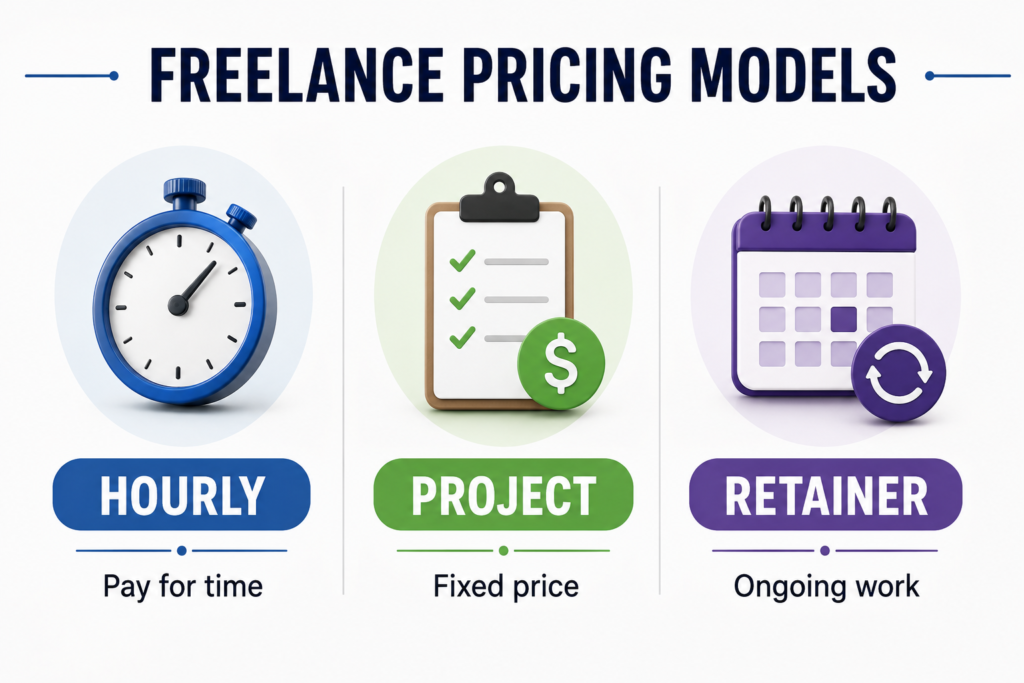
Should beginners charge hourly or per project?
There is no universal winner.
The right model depends on the work.
Hourly pricing
Hourly pricing is often the simplest starting point for beginners.
You charge:
hourly rate × tracked hours
It can work well when:
- the scope isn’t completely clear
- the client expects ongoing support
- tasks change regularly
- you’re still learning how long different tasks take
It also gives you useful data.
After completing ten similar projects, you may discover that a task consistently takes you three hours.
That information can eventually help you create a fixed-price package.
Project-based pricing
Project pricing means you agree on a total price for defined deliverables.
For example:
Website audit — $300
Includes one audit, one report and one 60-minute review call.
This can be better when the scope is clear.
The client knows the total investment.
You know what you need to deliver.
And once you become more efficient, you don’t automatically earn less just because you became faster.
The risk is underestimating the work.
Upwork’s current guidance on fixed-price projects specifically recommends understanding the full scope, estimating the time required and protecting against scope creep.
Value-based pricing
Value-based pricing is different.
Instead of primarily asking:
“How many hours will this take?”
you consider:
“What business value does this work create?”
This can work very well for experienced specialists who can demonstrate outcomes.
But it is usually harder for someone with no track record.
If you are genuinely at the beginning, don’t feel pressured to invent a huge “value-based” price when you cannot yet demonstrate the value.
Build the proof first.
How to turn your hourly rate into a freelance project price
Even if you eventually want to charge per project, your hourly rate is useful as an internal calculation.
Suppose your target internal rate is $30/hour.
You estimate:
- research: 2 hours
- production: 5 hours
- revisions: 2 hours
- client communication: 1 hour
- administration: 1 hour
Total estimated effort:
11 hours
$30 × 11 = $330
Now add a reasonable buffer for uncertainty.
If you estimate another 15%:
$330 × 1.15 = $379.50
You might quote:
$380
The client doesn’t need to see your internal calculation.
They need to see a clear scope, deliverables, timeline and price.
Your calculation protects you from accidentally accepting a $200 project that actually consumes 15 hours.
Don’t forget platform fees when setting your price
This is where beginners can make a surprisingly expensive mistake.
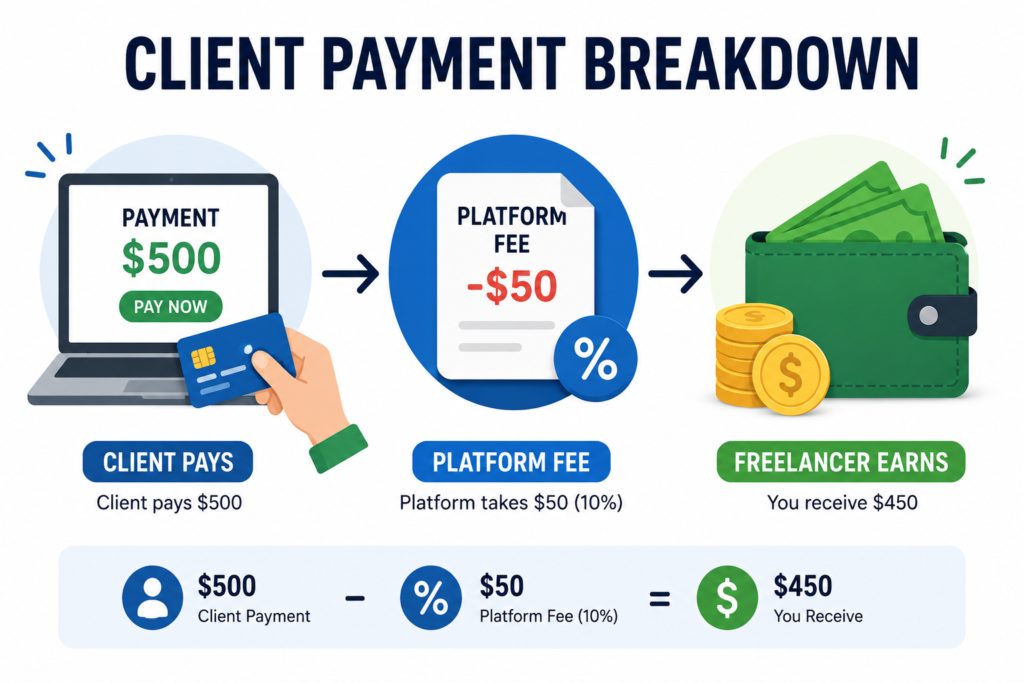
The amount the client pays isn’t always the amount you receive.
Upwork
Upwork currently says its freelancer service fee varies from 0% to 15%, depending on the contract.
So if your required take-home amount is $500, you need to know the applicable fee before deciding what to quote.
Don’t simply think:
“I need $500, so I’ll charge $500.”
Calculate your actual net.
Fiverr
Fiverr currently credits freelancers with 80% of the purchase amount on completed orders.
So a $100 order does not mean $100 in freelancer earnings.
If you need to receive $100 before taxes and other costs, the published price needs to be higher.
At an 80% earnings rate:
$100 ÷ 0.80 = $125
So a $125 order would produce $100 in earnings before your other costs.
Direct clients and other platforms
Direct clients may avoid marketplace commissions, but that doesn’t mean the work is free to administer.
You may still have:
- payment-processing costs
- invoicing
- contracts
- accounting
- taxes
- lead-generation costs
- unpaid sales conversations
The goal isn’t simply to avoid a platform fee.
The goal is to understand your true cost of getting paid.
That cost can also include invoicing software and payment processing, so compare the best invoicing software for freelancers before deciding how you will bill direct clients.
How much should a beginner charge for common freelance services?
Rather than pretending there is one universal beginner rate, use the following as practical starting bands, not official industry averages.
| Freelance service | Practical starting band | What can justify moving higher |
|---|---|---|
| Virtual assistance | $12–$20/hr | Specialized software, executive support, industry experience |
| General content writing | $15–$30/hr | SEO expertise, niche knowledge, strong portfolio |
| Graphic design | $15–$30/hr | Branding, UX, specialized design skills |
| Web design | $18–$35/hr | Strong portfolio, technical ability, integrations |
| Social media management | $15–$30/hr | Strategy, analytics, niche expertise |
| Video editing | $15–$35/hr | Motion graphics, advanced editing, commercial experience |
| Data analysis | $25–$45/hr | SQL, Python, BI tools, industry specialization |
These bands are intentionally conservative.
They are ToolSphera’s practical positioning suggestions derived from current marketplace reference ranges, not claims that every beginner should charge exactly these amounts.
For example, Upwork currently publishes $10–$20/hour for virtual assistants and $15–$35/hour for graphic designers, while more technical categories such as data analysis have substantially higher published ranges.
If your calculated minimum is higher than the suggested starting band, don’t blindly follow the table.
Your sustainability calculation wins.
What if your minimum rate is higher than the market?
This is where pricing gets interesting.
Suppose you calculate that you need $45/hour to make freelancing sustainable.
But similar beginners are charging $25/hour.
You have several choices.
Improve the offer
Instead of selling a generic service, specialize.
Narrow the scope
A smaller project can make the economics work better.
Target better clients
A different client segment may have a different budget.
Increase your proof
Build samples, testimonials and case studies.
Improve efficiency
If the same deliverable takes you eight hours today and five hours after experience, your economics improve.
What you shouldn’t do is automatically accept $25/hour indefinitely if $25/hour makes the business unsustainable.
How to quote your rate without sounding uncertain
Beginners often make their pricing conversation unnecessarily complicated.
You don’t need a long apology before saying your price.
Instead of:
“I’m still new to freelancing, so I’m not really sure, but maybe I could do it for around $100?”
say:
“For the scope you’ve described, my project fee is $100. That includes the agreed deliverables, one revision round and delivery within five business days.”
The second version doesn’t pretend you have ten years of experience.
It simply sounds like a professional who knows what they’re offering.
When the client asks for a discount
Don’t immediately cut the price.
Change the scope first.
For example:
“I can work within a $250 budget if we reduce the project to two deliverables and one revision round.”
That’s very different from:
“Sure, I’ll do the same $400 project for $250.”
The first protects the economics of your business.
The second simply reduces your pay.
What should you do if a client says your rate is too high?
First, don’t assume they’re correct.
A client saying “that’s expensive” can mean several things:
- the budget genuinely doesn’t fit
- they found a cheaper freelancer
- they don’t understand the scope
- they expected something different
- your offer wasn’t differentiated
- they simply negotiate every price
Ask a question before immediately discounting.
For example:
“Is the issue the overall project budget, or are there specific parts of the scope you’d like to adjust?”
That opens a conversation without immediately lowering your price.
If the scope changes, your price can change.
If the client simply wants the same work for less, you can decide whether the project is worth accepting.
When should a beginner raise their freelance rates?
Don’t raise your rates just because another freelancer on the internet charges more.
Raise them when you have evidence.
Useful signals include:
- your portfolio has improved
- you’ve completed several successful projects
- clients are happy with your work
- you have testimonials
- you’re getting repeat business
- clients accept your quotes without much resistance
- your schedule is becoming difficult to fill
- your skills have become more specialized
- the results you produce have improved
Upwork also recommends adjusting rates as experience, positive feedback and demand increase.
A simple rate-review system
You don’t need to wait until January every year.
Review your rate after meaningful milestones.
For example:
After the first few projects:
Review how long the work actually took.
After several strong testimonials:
Test a higher rate with new clients.
When your calendar starts filling:
Raise your price for new inquiries.
When you specialize:
Re-evaluate the market for the specialized service.
The important principle is:
Raise rates based on evidence, not anxiety or impatience.
Five freelance pricing mistakes beginners should avoid
1. Charging based on your employee salary
Freelancers don’t have the same cost structure as employees.
You may need to cover expenses and unpaid business time that an employer previously covered.
2. Copying the cheapest competitor
The cheapest price is rarely a useful benchmark.
3. Forgetting non-billable work
Proposals, calls, marketing, administration and client acquisition consume time.
4. Giving unlimited revisions
A cheap project can become an expensive project when “one small change” happens ten times.
Define revisions before starting.
5. Never changing your rate
Your first rate is a starting point.
It shouldn’t become your permanent identity.
How your first freelance client affects your pricing
Your first client is important, but don’t make the mistake of thinking:
“I need a client, therefore I’ll charge anything.”
Your goal is to get your first credible project.
That means the project should ideally give you at least one of these:
- portfolio material
- a testimonial
- relevant experience
- a useful case study
- a repeat-client opportunity
- stronger confidence in your process
This connects directly with our guide on how to get your first freelance client with no experience.
That article covers the acquisition side.
This article covers what happens when the client asks:
“How much do you charge?”
Your freelance rate should work with your client-acquisition strategy
Pricing doesn’t exist separately from getting clients.
If you are competing on a marketplace where clients can compare dozens of freelancers, your profile, portfolio, proposals and reviews influence how much your price is trusted.
That’s why Article in our freelancing cluster comes before this one: Best Freelancing Platforms for Beginners explains where beginners can look for work and how different platforms operate.
The sequence matters:
Find the right marketplace → get the first client → price the work sustainably → build proof → raise your rates.
Use time tracking to discover whether your pricing actually works
Your quoted rate can look good on paper and still produce poor results.
Suppose you charge $300 for a project.
You think:
“That’s a good $300 project.”
But after completing it, you discover that you spent:
- 7 hours doing the work
- 2 hours communicating
- 1 hour revising
- 1 hour handling administration
That’s 11 hours.
Your effective rate was:
$300 ÷ 11 = $27.27/hour
That number tells you much more than the original $300.
This is why tracking your time matters even when you use project-based pricing.
Our guide to free time tracking for freelancers covers the tools and methods you can use to measure where your working hours actually go.
A simple beginner freelance pricing formula you can reuse
If you want the entire article reduced to one process, use this:
Step 1: Calculate your floor
Annual income requirement ÷ annual billable hours = minimum sustainable hourly rate
Step 2: Research your market
Look at freelancers offering the same service to similar clients.
Step 3: Position yourself
Consider:
- skill
- experience
- portfolio
- niche
- client market
- complexity
- urgency
Step 4: Choose your pricing model
Use hourly pricing when the scope is uncertain.
Use project pricing when deliverables are clearly defined.
Use value-based pricing when you have enough expertise and evidence to justify it.
Step 5: Account for fees
Calculate what you actually keep after platform or payment fees.
Step 6: Quote the scope
Define:
- deliverables
- timeline
- revisions
- what’s excluded
- payment terms
Step 7: Track the real result
After delivery, calculate:
total project payment ÷ total hours spent = effective hourly rate
Step 8: Improve the next quote
If the project took longer than expected, adjust your estimate.
If the client accepted immediately and the work was more valuable than expected, consider testing a higher price next time.
That’s how your freelance pricing becomes better over time.
Frequently asked questions
How much should a beginner freelancer charge per hour?
There is no universal beginner rate. For many general freelance services, a practical starting point may fall around $15–$30/hour, while specialized or technical services can start higher. The better method is to calculate your minimum sustainable rate and compare it with current rates for your specific service.
What is a good freelance rate for beginners?
A good beginner rate is one that is sustainable, competitive for your service and defensible based on your current proof. You should generally avoid both extremes: pricing yourself so low that the work becomes unsustainable and pricing yourself like an established specialist before you have evidence to support it.
Should beginners charge hourly or per project?
Hourly pricing is often easier when you’re new and still learning how long work takes. Project pricing can work better once the deliverables are clearly defined and you understand your production time. Upwork and Contra both describe hourly and fixed/project models as useful in different situations.
How do I calculate my freelance hourly rate?
Add the income you need, business expenses and appropriate tax/benefit reserves, then divide that total by the number of hours you realistically expect to bill clients. Don’t assume every working hour is billable.
How much should I charge for my first freelance project?
Start with your internal hourly rate, estimate the complete project effort and add an appropriate buffer for uncertainty. Then quote the project based on clearly defined deliverables rather than simply guessing a round number.
Should I charge less because I have no experience?
You may need to position yourself below an established specialist in the same market if you don’t yet have comparable proof. But having little freelance history does not mean your underlying skill has no value. If you already have professional experience in the service, don’t automatically price yourself as a complete beginner.
Should I lower my rate to get my first client?
You can use an introductory price strategically, but don’t make permanent underpricing your business model. If you offer a lower price, reduce the scope or clearly treat it as a limited introductory offer.
How often should I raise my freelance rates?
Review your rates whenever your skills, proof, demand or specialization materially changes. You can also conduct a regular pricing review to see whether your effective rate and market position still make sense.
Should I charge different clients different rates?
Your rate can reasonably vary based on scope, complexity, urgency, client requirements and pricing model. But avoid arbitrary pricing that you cannot explain. The service and deliverables should remain clear.
How do platform fees affect freelance rates?
Platform fees reduce the amount you actually receive, so your pricing calculation should account for them. For example, Fiverr currently credits freelancers with 80% of completed-order value, while Upwork’s current freelancer service fee varies by contract.
Final takeaway
The hardest part of freelance pricing isn’t choosing between $20, $30 or $50.
It’s understanding why your number is what it is.
A sustainable beginner pricing strategy looks like this:
Calculate your minimum → research your market → position your offer → choose the right pricing model → define the scope → track your effective rate → raise your price as your proof grows.
Don’t try to win every client by being the cheapest.
Don’t copy an experienced freelancer’s rate without having comparable proof.
And don’t let one rejected quote convince you that your price is wrong.
Your first rate is not a verdict on your value.
It’s a starting hypothesis.
The market will give you feedback. Your completed projects will give you better data. Your portfolio will become stronger. Your service will become more specialized.
And eventually, your rate should reflect not only how long the work takes you, but how reliably you can solve the client’s problem. That is the point where freelancing starts becoming a business rather than simply selling hours.